Commercial Freezer Maintenance: Keeping Your Frozen Storage at Peak Performance
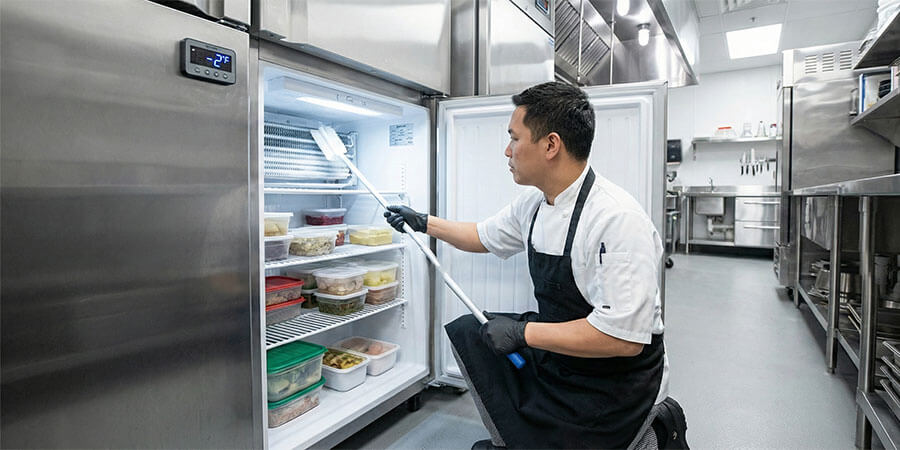
Table of Contents
Why Freezer Maintenance Demands a Different Approach Than Refrigerator Care - and What to Do About It
Commercial freezers operate at 0°F, work harder than refrigerators, and face unique challenges like frost buildup and defrost cycle management. This post covers the freezer-specific maintenance practices that protect food safety, prevent costly breakdowns, and extend equipment life.
Freezers and refrigerators share the same basic refrigeration cycle, but that's where the similarity ends. A commercial refrigerator holds food at 41°F. Your freezer has to hit 0°F - a full 41 degrees colder - which means the compressor works significantly harder, frost accumulates on evaporator coils, and cleaning requires defrosting first. The maintenance approach that works for your reach-in cooler won't cut it for your walk-in freezer.
The stakes are real. The FDA requires commercial freezers to maintain 0°F (-18°C), and USDA research confirms that freezing to 0°F inactivates bacteria, yeasts, and molds present in food. Let temperatures drift above that threshold and you're not just risking food quality - you're risking food safety. With 48 million Americans getting sick from foodborne illness each year (CDC), and foodborne illness costing an estimated seventy-five billion dollars annually (GAO 2025), proper freezer maintenance is a business necessity, not a nice-to-have.
The 0°F Standard: What It Means and How to Monitor It
The FDA is clear: commercial freezers must be maintained at 0°F (-18°C). Unlike refrigerators, where the FDA Food Code allows cold holding up to 41°F, there's no flexibility window for frozen storage. Food held at 0°F is safe indefinitely - only quality degrades over time. But food that fluctuates above 0°F repeatedly can develop ice crystals, texture changes, and eventually safety concerns if temperatures rise high enough.
Temperature monitoring for freezers requires more diligence than for refrigerators because the consequences of drift are less immediately obvious. A refrigerator running at 45°F is visibly problematic - food feels warm. A freezer running at 15°F still feels cold to the touch, but it's failing to meet the 0°F standard.
Practical monitoring steps:
- Place a calibrated thermometer in the warmest zone of the unit (typically near the door, away from the evaporator)
- Log temperatures at least twice daily - once at opening, once mid-service
- Set an alarm threshold at 5°F so you catch drift before it becomes a violation
- After any door is left open or a large product load is added, verify temperature recovery within two hours
For a broader look at safe temperature ranges across your cold storage equipment, the food temperatures guide covers the full spectrum from freezer to hot holding.
Defrost Cycle Management: The Maintenance Task Unique to Freezers
Refrigerators rarely need manual defrosting. Freezers always do - either automatically on a timer or manually when frost accumulates. This is the single biggest maintenance difference between the two equipment types, and mismanaging it causes more freezer problems than almost anything else.
Automatic Defrost Units
Most commercial reach-in freezers and many walk-in freezers use automatic defrost cycles, typically running two to four times per day. The system briefly heats the evaporator coils to melt accumulated frost, then drains the water away. Your job is to make sure the system is actually working.
Signs the automatic defrost is failing:
- Visible frost or ice buildup on evaporator coils or interior walls
- Unit running constantly without cycling off
- Temperatures gradually rising over days or weeks
- Unusual ice formations around the drain pan
If you see these signs, the defrost timer, heater, or thermostat may need replacement. This is a job for a certified technician - don't attempt to bypass or manually override the defrost system.
Manual Defrost Units
Chest freezers and some older reach-in units require manual defrosting. The rule of thumb: defrost when frost buildup reaches 1/4 inch on the evaporator coils. Thicker frost acts as insulation, forcing the compressor to work harder and driving up energy costs.
Manual defrost procedure:
- Remove all product and transfer to another freezer or insulated containers
- Turn the unit off or switch to defrost mode
- Place towels around the base to catch meltwater
- Allow frost to melt naturally - never use sharp tools to chip ice, which can puncture refrigerant lines
- Once defrosted, clean interior surfaces thoroughly (see cleaning section below)
- Dry completely before restarting
- Allow the unit to reach 0°F before reloading product
Ice and Frost Buildup: Causes and Prevention
Frost buildup is inevitable in any freezer, but excessive accumulation signals a problem. Understanding the causes helps you prevent them.
Warm, humid air entering the unit is the primary culprit. Every time a door opens, warm air rushes in and moisture freezes on the evaporator coils. In a busy kitchen, this happens dozens of times per shift. The solution isn't to open doors less - it's to minimize how long they stay open and ensure they seal completely when closed.
Door gasket failures accelerate frost buildup dramatically. A compromised gasket allows a constant trickle of warm air into the unit even when the door is closed. Check gaskets weekly using the dollar bill test: close a bill in the door and try to pull it out. If it slides free easily, the gasket needs replacement. Commercial refrigeration parts including replacement gaskets are available when you need them.
Drain line clogs cause a different kind of ice problem. When the drain line freezes or clogs, defrost water has nowhere to go and refreezes inside the unit. Flush drain lines monthly with warm water to keep them clear.
Walk-in freezer door heaters deserve special mention. Walk-in freezer doors include electric heaters in the door frame that prevent frost from sealing the door shut. If this heater fails, the door can freeze closed - a serious operational problem. Check that door frame heaters are functioning during monthly inspections.
Cleaning Your Commercial Freezer
Freezer cleaning differs from refrigerator cleaning in one critical way: you must defrost first. Trying to clean a frost-covered interior is ineffective and risks damaging the unit. For automatic defrost units, schedule cleaning to coincide with a defrost cycle. For manual defrost units, cleaning and defrosting happen together.
What you'll need:
- Mild dish soap or a cleaner formulated for food contact surfaces
- Warm water
- Soft cloths or non-abrasive sponges
- Approved sanitizing solution
- Food-grade lubricant for door hinges and hardware
Cleaning steps:
- Remove all product and store safely
- Complete the defrost process (see above)
- Wash all interior surfaces with mild soap and warm water
- Pay extra attention to corners, shelf tracks, and the area around the drain
- Rinse thoroughly - soap residue can affect food quality
- Apply sanitizing solution per manufacturer instructions and allow proper contact time
- Dry completely with clean cloths before restarting
- Lubricate door hinges and any moving hardware with food-grade lubricant
- Reload product only after the unit returns to 0°F
What to avoid: Harsh chemicals, ammonia-based cleaners, abrasive scrubbers, and hot water on frozen surfaces. Never use a heat gun or open flame to speed defrosting. Appropriate food equipment cleaners and degreasers formulated for cold storage are the right choice here.
Cleaning frequency depends on usage. High-volume operations should clean freezer interiors monthly. Lower-volume operations can extend to every six to eight weeks, but never go longer than that.
Maintenance by Freezer Type
Different freezer configurations have different maintenance priorities. Here's how the major types compare:
| Freezer Type: | Defrost Type: | Key Maintenance Focus: | Cleaning Frequency: |
| Reach-in upright | Automatic | Condenser coils, door gaskets, drain line | Monthly |
| Walk-in freezer | Automatic or manual | Door heaters, floor drains, evaporator coils, insulation | Monthly |
| Undercounter | Automatic | Condenser airflow, gaskets, drain pan | Monthly |
| Chest freezer | Manual | Frost buildup monitoring, manual defrost schedule | Every defrost cycle |
Reach-in freezers have front- or bottom-mounted condensers that collect dust and grease quickly in commercial kitchens. Clean condenser coils weekly - dirty coils increase energy consumption by an average of 17% according to Energy Star research. These units also benefit from checking that the door closes fully and latches properly after every service period.
Walk-in freezers require the most comprehensive maintenance. Beyond the standard tasks, inspect the door sweep and threshold seal monthly, check floor heaters (which prevent the floor from heaving due to frost), verify that the door closer pulls the door fully shut, and have the evaporator coils professionally cleaned annually. Walk-in freezer insulation panels should be inspected for moisture intrusion, which compromises insulating value over time.
Undercounter freezers face airflow challenges from their location. Ensure nothing blocks the condenser vent - a common problem when items are stored on top of or directly in front of the unit. These compact units have less thermal mass, so temperature recovery after door openings is slower.
Chest freezers are the most maintenance-intensive in terms of defrosting, since virtually all require manual defrost. The upside: their top-opening design means cold air doesn't spill out when opened, reducing frost accumulation from door openings. Organize product in labeled containers so staff aren't digging through the unit with the lid open. Proper food storage containers with tight-fitting lids also reduce freezer burn on stored product.
Warning Signs That Need a Technician
Some freezer problems are DIY-fixable. Others need a certified refrigeration technician. Knowing the difference saves time and prevents making things worse.
Call a technician when you see:
- Compressor running constantly without cycling off - indicates refrigerant issues, a failed thermostat, or a compressor nearing the end of its life
- Ice forming on refrigerant lines outside the unit - suggests a refrigerant leak or airflow problem
- Unusual noises - grinding, squealing, or banging from the compressor or fan motors
- Temperatures that won't recover after a door opening or product load, even after two hours
- Defrost system failures - frost accumulating rapidly on an automatic defrost unit
- Electrical issues - tripped breakers, burning smells, or visible damage to wiring
Preventive maintenance extends commercial refrigeration equipment lifespan by up to 30% (Tech24 2022). Catching these warning signs early and acting on them is how you get there. If you're unsure whether a symptom warrants a service call, the troubleshooting guide for commercial refrigerator repair issues can help you assess the situation. And if the unit is older and repairs are becoming frequent, signs it's time to replace a refrigerator applies equally to freezers.
Frequently Asked Questions
What temperature should a commercial freezer maintain?
The FDA requires commercial freezers to maintain 0°F (-18°C). This is significantly colder than the 41°F cold holding requirement for refrigerators. Food stored at 0°F is safe indefinitely - only quality degrades over time. Monitor temperatures at least twice daily with a calibrated thermometer and log the readings. If your unit can't hold 0°F consistently, it needs service.
How often should I defrost a commercial freezer?
For manual defrost units, defrost when frost buildup reaches 1/4 inch on the evaporator coils - typically every one to three months depending on how often the door is opened. For automatic defrost units, you don't manually defrost, but you should verify the automatic cycle is working by checking for frost accumulation. If frost is building up on an automatic unit, the defrost system needs service.
Can you clean a freezer without defrosting it first?
Not effectively. Frost-covered surfaces can't be properly cleaned or sanitized, and applying cleaning solutions to frozen surfaces is largely ineffective. For automatic defrost units, schedule cleaning to coincide with a defrost cycle. For manual defrost units, cleaning and defrosting happen together as part of the same process. Always allow the unit to fully defrost before cleaning, then dry completely before restarting.
What causes excessive frost buildup in a commercial freezer?
The most common causes are a damaged or worn door gasket allowing warm air infiltration, a malfunctioning automatic defrost system, a clogged drain line causing meltwater to refreeze, or staff leaving the door open too long during service. Check door gaskets weekly using the dollar bill test. If gaskets are intact and the door is being used properly, the defrost system or drain line is likely the culprit.
What's the difference between maintaining a walk-in freezer vs. a reach-in freezer?
Walk-in freezers require additional attention to door frame heaters (which prevent the door from freezing shut), floor heaters (which prevent frost heave), floor drains, and larger evaporator coils that typically need annual professional cleaning. Reach-in freezers focus more on condenser coil cleaning, door gaskets, and drain pan maintenance. Both types need regular temperature monitoring, but walk-ins have more components that can fail.
How do I prevent freezer burn on stored food?
Freezer burn happens when food is exposed to air inside the freezer. Use airtight, properly sealed containers for all stored product. Wrap proteins tightly before freezing. Minimize the time the freezer door is open during service. Maintain consistent 0°F temperatures - temperature fluctuations accelerate freezer burn. Rotate stock using FIFO (first in, first out) so nothing sits in the freezer longer than necessary.
My commercial freezer door was left open overnight. What should I do?
First, check the temperature of all stored product with a food thermometer. Any food that has risen above 0°F and shows signs of partial thawing should be evaluated carefully - food that has thawed but remained at 41°F or below can be refrozen, but quality will suffer. Food that reached temperatures above 41°F for more than two hours should be discarded. Document what happened and what you discarded for your records. Then inspect the unit for frost accumulation and allow it to return to 0°F before resuming normal use. For more on food safety decisions in these situations, see our food safety guide.
Related Resources
- Commercial Refrigeration Routine Maintenance - Maintenance schedules and best practices for refrigerators and coolers
- Food Safety Guide - Comprehensive food safety practices for commercial kitchens
- Commercial Refrigeration Types Guide - Overview of refrigeration equipment categories and how to choose the right unit
- Troubleshooting Refrigerator Repair Issues - Diagnosing common refrigeration problems before calling a technician
- Commercial Refrigeration Equipment - Browse freezers, refrigerators, and cold storage equipment
Share This!