Holiday Catering Tips for Christmas and New Year's Eve Parties
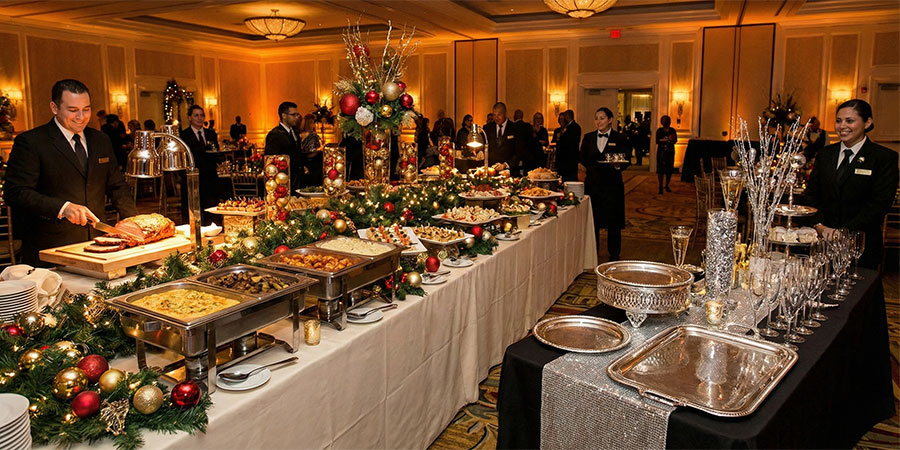
Table of Contents
How to plan, staff, and execute holiday catering that keeps guests happy and your operation running smoothly all season
The holiday season is the most demanding stretch of the year for catering operations - and the most lucrative. This post covers the operational side of holiday catering: when to lock in bookings, how to build a seasonal menu that sells, how to staff through the crunch, and how to keep food safe at large gatherings. Whether you're catering Christmas dinners, New Year's Eve parties, or a full calendar of corporate holiday events, these tips will help you execute with confidence.
November through January doesn't sneak up on experienced caterers - but it still has a way of feeling like it did. Between Christmas parties, Hanukkah dinners, New Year's Eve countdowns, and the wave of corporate events that fills December, the window between "we should start planning" and "the event is tomorrow" closes faster than most operators expect.
Q4 is the industry's biggest quarter. According to the National Restaurant Association's Economic Indicators report, Q4 2025 restaurant sales topped 300 billion dollars - a record. That revenue doesn't happen by accident. It's built on operators who planned early, staffed smart, and executed cleanly under pressure.
This post is about the operational side of holiday catering. Not what equipment to buy (see our guide on off-premise catering equipment for that), and not how to market your holiday services (that's covered in holiday marketing ideas). This is about how to actually run the thing - from the first booking call to the last chafing dish packed up.
Start Booking Earlier Than You Think You Need To
The single biggest operational mistake holiday caterers make is treating October like there's still time. There isn't.
According to the National Retail Federation's 2025 consumer survey, 42% of holiday shoppers start planning before November. Your clients are no different. Corporate event planners book venues and caterers in September and October. Families planning Christmas dinners often lock in catering by early November. By the time December arrives, the best dates are gone.
What a realistic booking timeline looks like:
| Milestone: | Target Date: |
| Open holiday booking calendar | August - September |
| Send outreach to past clients | September |
| Finalize holiday menu offerings | October 1 |
| Confirm staffing plan | October 15 |
| Soft cutoff for new bookings | November 15 |
| Final headcount confirmations | 5-7 days before each event |
| Equipment and supply orders confirmed | 2 weeks before each event |
The earlier you close your calendar, the more control you have over staffing, sourcing, and logistics. Operators who take bookings through mid-December are setting themselves up for chaos.
Deposits and contracts matter more in Q4. Holiday events have a higher no-show and last-minute cancellation rate than other times of year. Require a non-refundable deposit - typically a meaningful percentage of the total - and spell out your cancellation policy in writing before any planning begins.
Build a Holiday Menu That's Specific, Not Generic
A holiday catering menu shouldn't look like your regular catering menu with a sprig of holly on it. Guests expect something that feels seasonal, and the National Restaurant Association's 2026 What's Hot report points to a clear trend: comfort and nostalgia with a global twist, alongside health and wellness options that don't feel like an afterthought.
That combination is actually a useful framework for holiday menus. Think roasted root vegetables with harissa, braised short rib with gremolata, or a classic prime rib station alongside a lighter citrus-dressed grain salad. The familiar anchors the menu; the twist makes it memorable.
Christmas vs. New Year's Eve: Different Menus, Different Formats
These two holidays call for different approaches, and your menu should reflect that.
Christmas events tend to be family-oriented or company dinners. Guests want warmth and abundance - roasts, sides, bread, dessert. Buffet-style service works well here because it lets people go back for more and accommodates dietary variety across a large group. Think carved proteins, hot sides in chafing dishes, and a dessert station.
New Year's Eve events skew later, louder, and more cocktail-forward. Heavy passed appetizers, small plates, and a midnight moment (a champagne toast, a dessert display, a late-night snack station) tend to land better than a full sit-down dinner. Guests are often standing, mingling, and grazing rather than sitting down for a structured meal.
Practical Menu Planning Tips
- Limit your menu. More options mean more prep, more holding equipment, and more food safety risk. A focused menu of eight to twelve items executes better than twenty.
- Plan for dietary needs upfront. Ask clients about dietary restrictions when booking, not the week before. Build at least one vegetarian, one gluten-free, and one dairy-free option into every menu.
- Anchor around what holds well. Braised meats, roasted vegetables, grain dishes, and soups hold temperature and texture far better than delicate proteins or anything that needs to be served immediately after cooking.
- Don't forget the midnight moment. For New Year's Eve specifically, plan a late-night station or dessert drop timed to midnight. It's a small touch that guests remember.
For more on structuring a catering menu from scratch, see our guide on building a catering menu.
Staffing Through the Holiday Crunch
Labor is the hardest part of holiday catering, and the numbers back that up. The National Restaurant Association reported that 70% of operators had unfilled positions at holiday peak in 2025. A 7shifts workforce report from late 2024 found that 65% of restaurant managers described the labor market as "tight" or "very tight."
That's the environment you're operating in. Here's how to work within it.
Lock In Your Core Team First
Your experienced staff - the people who know your systems, your standards, and how to handle a 200-person event without being told - are your most valuable asset in Q4. Talk to them in September. Find out their availability, what events they want to work, and what they need to stay committed through the season. Losing a key team member in December because you didn't have the conversation in October is an avoidable problem.
Hire and Train Seasonal Staff Early
If you need additional staff for the holiday season, start recruiting in September and have them trained by late October. Seasonal hires who show up for their first shift the week of a major event are a liability, not an asset. Give them time to learn your setup, your service standards, and your food safety protocols before the pressure is on.
Build Redundancy Into Every Event
For any event over 75 guests, plan for at least one more staff member than you think you need. Equipment fails, guests arrive early, headcounts run over - something always happens. The operator who has a spare set of hands available handles it. The one who's running exactly at capacity scrambles.
Communicate Clearly About Holiday Pay and Scheduling
The 144% average restaurant turnover rate (National Restaurant Association) is a reminder that staff have options. If you want reliable people working Christmas Eve and New Year's Eve, be upfront about compensation, scheduling expectations, and any perks you're offering for holiday shifts. Surprises in either direction - good or bad - tend to come out in the weeks before the event.
Food Safety at Large Holiday Gatherings
Large gatherings and food safety risks go together. The FDA estimates 48 million cases of foodborne illness occur in the United States each year, resulting in 128,000 hospitalizations. Holiday catering - with its large volumes, extended holding times, and often unfamiliar venues - creates real exposure if you're not disciplined about it.
The core rule is simple: perishable foods must be refrigerated within 2 hours of preparation, or within 1 hour if the ambient temperature is above 90°F (FDA, 2024). At a holiday event, that clock starts the moment food comes off the heat or out of the cooler.
The Holiday Food Safety Checklist
Before the event:
- Confirm the venue has adequate refrigeration or plan to bring your own cold storage
- Check that all food holding and warming equipment is calibrated and functioning
- Brief all staff on temperature requirements and the 2-hour rule
- Pack a probe thermometer for every event - not one for the whole team, one per station
During the event:
- Monitor hot food temperatures every 30 minutes; hot food must stay at 135°F or above
- Monitor cold food temperatures; cold food must stay at 41°F or below
- Label and timestamp any food that's been out for more than 90 minutes
- Discard anything that's been in the temperature danger zone (41°F - 135°F) for more than 2 hours
After the event:
- Cool leftovers rapidly - from 135°F to 70°F within 2 hours, then to 41°F within the next 4 hours
- Never pack hot food directly into transport containers without cooling first
- Document any food that was discarded and why
For a deeper look at food safety requirements for catering operations, see our food safety guide and our post on food safety practices.
Holiday Buffet Logistics: Making the Line Move
A buffet that backs up is a buffet that fails. At holiday events, where guests are often dressed up, holding drinks, and trying to have conversations, a slow or chaotic buffet line creates friction that guests remember - and not fondly.
Layout Principles That Actually Work
Start with the plates, end with the proteins. Put plates at the beginning of the line and the most popular items (carved meats, main proteins) toward the end. This keeps the line moving because guests aren't stopping to load up on the anchor item before they've even seen the rest of the spread.
Run two lines when possible. For events over 100 guests, mirror your buffet setup so guests can approach from both sides. This cuts wait times roughly in half and reduces the bottleneck at popular stations.
Keep replenishment invisible. Guests shouldn't see you running out of food and scrambling to refill. Stage backup pans in steam tables or warming equipment behind the line, and swap them out before the front pan is empty.
Use insulated catering bags for transport. If you're moving food from a prep kitchen to a venue, insulated bags are what keep your hot food hot and your cold food cold during transit. Don't rely on the venue's equipment to do the work your transport should have done.
Timing the Buffet for New Year's Eve
New Year's Eve events have a natural rhythm: cocktail hour, dinner service, countdown, late-night. If you're catering a full evening, plan your buffet timing around that structure. Opening the dinner buffet too early means guests are done eating by 9 PM and the energy drops. Opening it too late means hungry guests who've been drinking for two hours. A dinner buffet that opens around 7:30 - 8:00 PM for a midnight countdown event tends to hit the right rhythm.
After the Event: The Follow-Up That Builds Next Year's Business
Most catering operators focus entirely on execution and treat the post-event period as cleanup. That's a missed opportunity.
The days immediately after a successful holiday event are when client satisfaction is highest and the memory is freshest. That's the moment to:
- Send a thank-you message within 24-48 hours. Keep it brief and genuine.
- Ask for feedback. A short, direct question ("Was there anything we could have done better?") surfaces issues before they become online reviews and shows clients you care about quality.
- Offer early booking for next year. If the event went well, mention that you're already taking bookings for next holiday season and that past clients get priority. Many will say yes on the spot.
- Document what worked and what didn't. Before the details fade, write down what you'd change - menu items that underperformed, staffing gaps, timing issues. That document is worth more than any planning template when you're building next year's calendar.
The operators who build strong holiday catering businesses aren't just good at executing events. They're good at turning one successful event into a long-term client relationship.
Frequently Asked Questions
How far in advance should I start planning holiday catering events?
For large events (100+ guests), planning should start three to four months out. For smaller gatherings, six to eight weeks is a reasonable minimum. The earlier you lock in bookings, the more control you have over staffing, sourcing, and logistics during the busiest season of the year.
What's the difference between catering a Christmas party and a New Year's Eve event?
Christmas events tend to be more family-oriented or formal dinner-style, with guests expecting warmth and abundance - roasts, sides, dessert. New Year's Eve skews later and more cocktail-forward, with guests grazing and mingling rather than sitting for a structured meal. Your menu format, service style, and timing should reflect those differences.
How do I handle dietary restrictions for large holiday gatherings?
Ask about dietary restrictions at booking, not the week before. Build at least one vegetarian, one gluten-free, and one dairy-free option into every holiday menu. Label everything clearly at the buffet so guests can make informed choices without having to ask staff.
What's the most important food safety rule for holiday catering?
The 2-hour rule: perishable foods must be refrigerated within 2 hours of preparation (or 1 hour if the ambient temperature is above 90°F). At large events with extended service times, this requires active monitoring - not just setting food out and hoping for the best. Check temperatures every 30 minutes and discard anything that's been in the danger zone too long.
How do I staff holiday events when the labor market is tight?
Start early. Talk to your core team in September, recruit seasonal staff by October, and have everyone trained before November. Build redundancy into every event - plan for at least one more staff member than you think you need. Be transparent about holiday pay and scheduling expectations upfront.
How do I keep a holiday buffet line moving efficiently?
Put plates at the start of the line and popular proteins at the end. For events over 100 guests, mirror the buffet so guests can approach from both sides. Keep backup pans staged and swap them before the front pan empties - guests shouldn't see you running out of food.
What should I do after a holiday catering event to build repeat business?
Send a thank-you within 24-48 hours, ask for brief feedback, and offer early booking priority for next year. Document what worked and what didn't while the details are fresh. The post-event window is when client satisfaction is highest - use it.
Related Resources
- Chafing Dish Buying Guide - How to choose the right hot holding equipment for buffets and catering events
- Food Safety Guide - Temperature requirements, HACCP basics, and food safety compliance for foodservice operations
- Building a Catering Menu - How to structure a catering menu from scratch, including pricing strategy and format options
- Off-Premise Catering Equipment - What equipment you need to cater events safely outside your kitchen
- Catering Equipment and Supplies - Browse the full range of catering equipment for holiday events
Share This!