Catering Menu Ideas: How to Build a Catering Menu
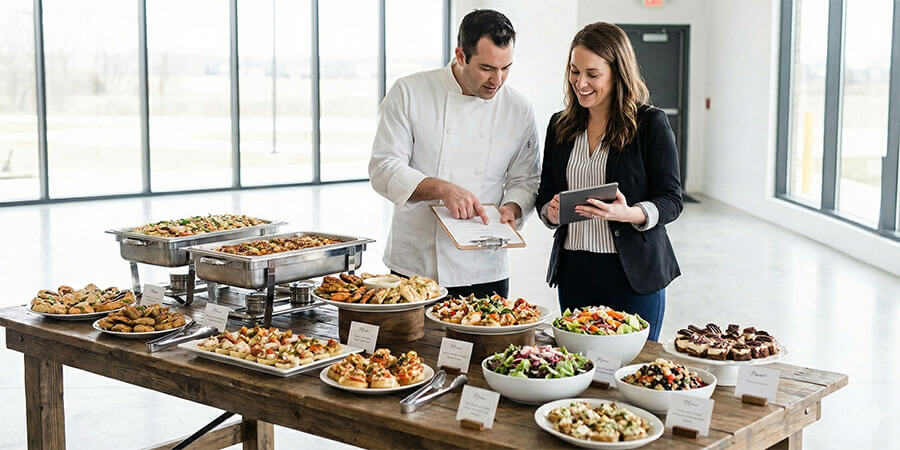
Table of Contents
A practical framework for restaurant operators building or expanding a catering menu that attracts clients and scales
Catering now accounts for 11% of total food service revenue, and the U.S. catering market is projected to grow at 6.2% annually through 2032, according to the Curate 2025 Catering Industry Report. Yet many restaurant operators still treat catering as an afterthought - a side revenue stream with no dedicated menu, pricing strategy, or format structure. This post walks through how to build a catering menu from scratch, covering format selection, menu composition, dietary accommodations, portion planning, and packaging - all backed by current industry data.
Catering is no longer a nice-to-have for restaurant operators - it is a growth engine. The Curate 2025 Catering Industry Report found that over 53% of corporate buyers plan to increase their catering budgets, with 80% ordering at least once a month and 32% placing weekly orders. The National Restaurant Association's 2026 What's Hot Culinary Forecast lists local sourcing, allergen-friendly menus, and clear menu labeling among the top 10 trends shaping the industry - all of which directly impact how catering menus should be designed.
But a catering menu is not just your dine-in menu in bigger quantities. The formats are different, the portions change, dietary expectations are higher, and your pricing model needs to account for labor, packaging, transport, and setup that do not exist with table service. Getting the menu right is the foundation everything else builds on.
Choose the Right Catering Format for Your Operation
The first decision is not what to cook - it is how the food will be served. Your format determines everything from your prep workflow to your packaging costs to how many staff you need on-site. Most catering operations offer two or three formats that fit their kitchen's capabilities.
Buffet-style service remains the most common format for mid-size to large events. Guests serve themselves from chafing dishes, and you can prepare in volume with relatively low on-site labor. Buffets work well for corporate lunches, holiday parties, and community events. The tradeoff is food waste - you need to overprepare proteins by 10-20% to ensure the last guest in line is not staring at empty pans.
Individually packaged meals have surged in demand. ezCater's 2024 Feeding the Workplace report found that 64% of employees prefer individually packaged meals when their employer provides food. Boxed lunches and individually sealed entrees reduce waste, simplify dietary accommodations, and eliminate the need for on-site serving staff. They also work well for delivery-only operations that lack the labor for on-site event staffing.
Plated service is the premium tier - full table service with courses, typically for weddings, galas, and high-end corporate events. It requires trained service staff, precise timing, and a kitchen that can plate 50 to 500 identical dishes in a narrow window. Most restaurants adding catering for the first time should start with buffet and boxed formats before attempting plated service.
| Format: | Best For: | Staff Needed: | Waste Level: | Margin Potential: |
| Buffet | Corporate events, parties, community functions | Low - moderate | Moderate - high | Good |
| Boxed / individually packaged | Office lunches, recurring orders, delivery-only | Low | Low | Very good |
| Plated | Weddings, galas, formal dinners | High | Low | Highest (if priced correctly) |
| Food stations / build-your-own | Casual events, cocktail hours, team gatherings | Moderate | Moderate | Good |
Food stations and build-your-own bars - taco bars, grain bowl stations, salad bars - deserve consideration as a fourth format. They combine the volume efficiency of buffets with the personalization that clients increasingly expect. The NRA's 2026 forecast highlights allergen-friendly menus and clear menu labeling as top trends, and interactive stations naturally accommodate both by letting guests control what goes on their plate.
Structure Your Menu Around Categories, Not Just Dishes
A common mistake is building a catering menu as a single long list of items. Clients scanning your menu need to assemble a complete meal quickly - that means organizing by category so they can pick one protein, two sides, a salad, and a dessert without guesswork.
Core menu categories for most catering operations:
- Proteins - Offer 4-6 options spanning price points. Include at least one poultry, one beef or pork, one seafood, and one plant-based option. The NRA's 2026 forecast identifies proteins as add-ons as a top 10 trend, reflecting how guests increasingly want to customize their meals.
- Sides and starches - 6-8 options that pair with any protein. Seasonal sides keep your menu fresh and your food costs lower.
- Salads - 2-4 options, with at least one that is hearty enough to serve as a standalone entree for vegetarian guests.
- Appetizers and starters - Essential for cocktail hours and multi-course events. Plan 4-6 pieces per person for cocktail-style service.
- Desserts - 3-5 options. Dessert is where perceived value often exceeds food cost, making it a strong margin category.
- Beverages - Even if you only offer non-alcoholic options, list them. Coffee service, house-made lemonade, and iced tea by the gallon are high-margin additions that clients expect.
Keep your total menu manageable. A catering menu with 8-12 items per category gives clients enough variety to feel like they have choices without overwhelming your kitchen with prep complexity. You can always expand once your operation is running smoothly.
For guidance on how menu structure affects customer decisions and average check size, our restaurant menu design guide covers layout and organization principles that apply to catering menus as well.
Plan for Dietary Accommodations From the Start
Dietary accommodations are not a niche concern - they are a baseline client expectation. The ezCater 2024 report found that 71% of employees prefer to select meals themselves when employers provide food, which means your menu needs to clearly communicate what each item contains and what restrictions it meets.
Allergen-friendly menus ranked sixth on the NRA's 2026 top 10 trends, and clear menu labeling ranked fifth. Clients planning events for 20, 50, or 200 people will always have guests with restrictions. If your menu does not address this upfront, you lose the booking to a competitor who does.
At minimum, every catering menu should include:
- At least one gluten-free entree and side (not just a salad)
- At least one vegan entree that is genuinely satisfying - not an afterthought side dish
- At least one nut-free option prominently labeled
- Clear allergen icons or labels on every menu item
Build substitution logic into your standard packages. When a client orders your grilled chicken buffet for 50, they should be able to swap 10 portions for a plant-based protein without a separate phone call. Standardized substitution options streamline your kitchen prep while showing clients you have thought through their needs.
For more ideas on making your menu inclusive, our post on accommodating vegan guests covers practical changes that apply to both dine-in and catering service.
Get Portion Sizing Right for Catering
Portion sizing for catering is not the same as plating a dine-in entree. You are feeding groups where people serve themselves, graze over longer periods, and often eat less per item but sample more variety. Getting portions wrong means either running out of food - which is a client relationship killer - or throwing away significant volume, which destroys your margins.
General per-person portions for catering:
| Category: | Per-Person Portion: | Notes: |
| Protein (main course) | 6-8 oz cooked weight | Budget 10-20% extra for buffets |
| Sides and starches | 4-6 oz | Plan 2 sides per guest minimum |
| Salad | 1-2 cups | Tossed salads need more volume than composed |
| Appetizers (cocktail hour) | 4-6 pieces | More if appetizers replace a meal course |
| Dessert | 1-2 pieces or 4-6 oz | Variety drives higher consumption |
| Beverages | 8-12 oz per serving, 2-3 servings | Provide 1.5x expected consumption for coffee |
Buffet overage matters. For buffet-style service, order 10-20% more protein than your headcount suggests. The last third of guests through a buffet line will take larger portions if items look scarce, and running out mid-service is far more expensive in lost reputation than a slight overage in food cost.
Request final headcounts at least 24 hours in advance. Build this into your catering terms and make it non-negotiable. A client who adds 15 guests the morning of the event is not giving you a "bigger order" - they are creating a food shortage that reflects on your operation, not theirs. For more on managing food costs across your operation, our post on keeping restaurant food costs low covers strategies that apply to both dine-in and catering.
Price Your Catering Menu to Protect Margins
Catering margins can be strong, but only if your pricing accounts for the full cost of service - not just food. Many operators underprice catering because they apply their dine-in food cost percentages without factoring in packaging, transport, setup labor, and the opportunity cost of tying up their kitchen for off-premise production.
Target a food cost percentage of 28-35% for catering, which aligns with industry benchmarks reported by the Curate 2025 Catering Industry Report. High-performing catering operations can achieve net margins of 10-15%, but only when pricing captures the full cost stack.
Costs your catering pricing must cover:
- Food cost - Ingredients, plus 10-20% overage for buffets
- Packaging - Containers, lids, utensils, napkins, serving equipment. ezCater's 2024 report found that 43% of orderers prefer sustainable packaging and 37% of workplaces now require it - which typically costs more than standard disposables
- Transport - Fuel, vehicle wear, hot and cold holding equipment
- Labor - Prep time, packing, delivery, on-site setup and breakdown (if applicable)
- Equipment - Chafing dishes, serving utensils, linens (whether rented or owned)
Use per-person pricing for packages and per-item pricing for a la carte. Per-person pricing simplifies the client's decision and lets you bundle high-margin items (sides, beverages, desserts) with lower-margin proteins. Clients prefer knowing "it costs X per person for everything" over calculating individual item quantities.
For a deeper dive into pricing strategy, our restaurant menu pricing guide covers cost-plus, competition-based, and value-based approaches - all of which apply to catering.
Package and Present Your Catering Menu for Clients
How you present your catering menu matters as much as what is on it. Corporate buyers - who represent the fastest-growing catering segment - often compare three to five caterers side by side. The Curate 2025 report found that 75% of catering orders happen online, which means your menu needs to sell itself without a salesperson explaining it.
Create a standalone catering menu. Do not bury catering options on the last page of your dine-in menu or in a PDF that requires a phone call to access. Build a dedicated catering section on your website or a separate downloadable menu that includes descriptions, dietary labels, per-person pricing, minimums, and lead time requirements.
Build packages around common event types. Instead of asking clients to build a meal from scratch, offer preset packages for the most common scenarios - corporate lunch for 15, holiday party for 50, breakfast meeting for 25. Packages reduce decision fatigue for the client and give you more control over food cost and prep efficiency.
Invest in packaging that reflects your quality. Sustainable packaging is now a competitive differentiator, not just a nice-to-have. The NRA's 2026 forecast ranks compostable and reusable packaging as a top 10 trend, and ezCater's data shows that over a third of corporate clients require sustainable packaging as a company policy. Your containers, labels, and presentation should communicate the same quality as your food. Browse disposables and packaging options to find solutions that match your operation's needs. For transport, the right storage and transport equipment keeps food at safe temperatures and looking presentable on arrival.
Reduce Waste and Manage Inventory for Catering
Catering introduces inventory challenges that dine-in service does not. You are committing to specific quantities days in advance, prepping in larger batches, and often cooking in a single push rather than throughout service. Without a system, waste can quietly eat your margins.
Track catering food cost separately from your dine-in operation. Blending the two makes it impossible to see which side of your business is profitable and which is leaking money. A simple spreadsheet tracking ingredients ordered, portions served, and leftovers returned per event will reveal patterns within a month.
Build a repurposing plan for overproduction. When you over-prep proteins or sides, have a plan for using them the next day - staff meals, daily specials, or ingredient components for your dine-in menu. The 10-20% overage that buffet service requires does not have to become waste if your kitchen knows what to do with it. Our post on reducing restaurant food waste covers strategies that directly apply to catering leftovers.
Standardize your prep lists. For every package you offer, create a master prep list that specifies exact quantities per headcount tier - 10, 25, 50, 100 guests. This eliminates guesswork, speeds up kitchen prep, and ensures consistency whether it is your head chef or a line cook assembling the order.
Frequently Asked Questions
How many items should a catering menu include?
Most successful catering menus offer 8-12 items per category - proteins, sides, salads, appetizers, desserts, and beverages. This gives clients enough variety to feel like they have choices while keeping your kitchen prep manageable. You can always expand as your catering volume grows and you learn which items sell and which sit.
What is the biggest mistake restaurants make when starting a catering operation?
Underpricing. Many operators apply their dine-in food cost assumptions to catering without accounting for packaging, transport, setup labor, and overage. The result is catering that looks busy on the revenue line but barely breaks even or loses money when all costs are factored in. Build a complete cost model before setting prices.
How far in advance should clients order catering?
For standard buffet or boxed meal orders, 48-72 hours of lead time is reasonable. For large events over 50 guests, plated service, or custom menus, require at least one to two weeks. Build your lead time requirements into your menu and ordering process so clients know upfront.
Should I use the same recipes for catering that I use for dine-in?
Some recipes translate directly, but many need adjustment. Dishes that hold well at temperature - braises, roasted proteins, grain salads, hearty sides - work better for catering than items that degrade quickly like fried foods or delicate sauces. Test how each dish performs after 30-60 minutes in a hot holding unit before adding it to your catering menu.
How do I handle dietary restrictions for large groups?
Build accommodations into your standard menu rather than treating them as special requests. Include at least one gluten-free, one vegan, and one nut-free option as default offerings. Use clear allergen labels on your menu and on packaging. The NRA's 2026 trend data shows allergen-friendly menus and clear labeling are among the top industry priorities - clients expect this.
Is it worth offering catering delivery or should I require pickup?
Delivery is strongly preferred by corporate clients, who represent the fastest-growing catering segment. The Curate 2025 report found that 75% of catering orders happen online, and the ezCater 2024 report found that 90% of orderers are more likely to order from a caterer offering delivery tracking. Delivery does add cost, but it significantly expands your addressable market.
How do I market my catering menu once it is ready?
Start with your existing customer base. Every dine-in guest is a potential catering client for their workplace or personal events. Add a catering section to your website, include a catering insert with every takeout order, and post your packages on social media. For corporate accounts, direct outreach to local offices and event planners is the most effective channel. For a deeper look at building your marketing funnel, see our restaurant marketing guide.
Related Resources
- Restaurant Menu Design Guide - Layout and structure principles for menus that sell
- Restaurant Menu Pricing Guide - Cost-plus, competition-based, and value-based pricing strategies
- Holiday Catering Tips - Seasonal catering strategies for peak holiday demand
- How to Reduce Restaurant Food Waste - Waste reduction strategies for dine-in and catering
- Restaurant Marketing Guide - Complete marketing framework for food service businesses
Share This!