Rice Cooker Guide
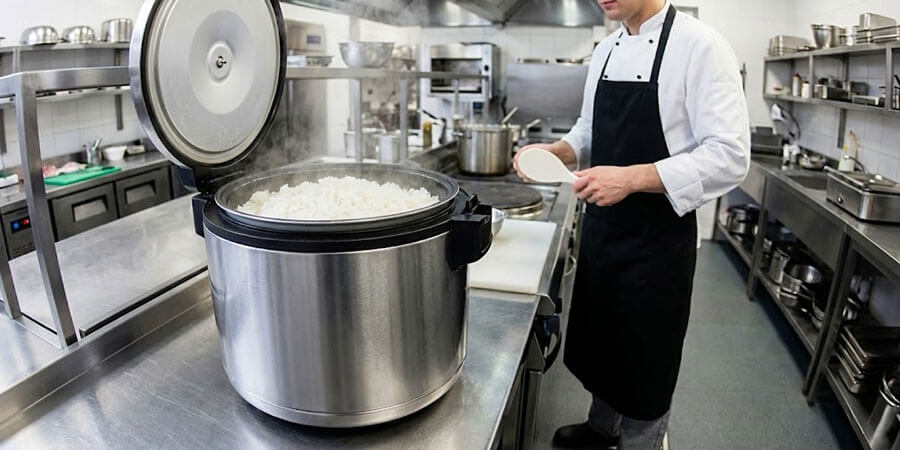
Table of Contents
What is a Rice Cooker?
A commercial rice cooker transforms one of the most labor-intensive kitchen tasks into a hands-off operation. Unlike stovetop methods that demand constant attention - adjusting heat, timing, and water ratios - a dedicated rice cooker delivers consistent results batch after batch, freeing your staff to focus on proteins, sauces, and plating. Whether you run a high-volume Asian restaurant producing hundreds of servings per shift or a cafeteria that needs reliable side dishes, the right rice cooker ensures perfectly cooked grains without the guesswork.
How Rice Cookers Work
Rice cookers operate on a simple but effective principle. A heating element beneath the inner metal bowl heats water to steam, which the rice absorbs during cooking. A built-in thermostat monitors the temperature continuously. Once all the water has been absorbed and the temperature inside the bowl rises above the boiling point of water (indicating the rice is done), the cooker automatically shuts off or switches to a lower-wattage warming mode. This automatic shutoff is what makes rice cookers so reliable, there's no guessing when the rice is ready or risk of burning the bottom of the pot.
Types of Rice Cookers by Power Source
The first major decision is how your rice cooker will be powered. Each option serves different kitchen environments and volume requirements.
Electric Rice Cookers
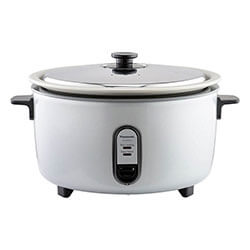
Electric rice cookers are the most common choice for commercial kitchens, offering plug-and-play convenience and precise temperature control. Simply place the unit on any countertop with access to the appropriate outlet, add rice and water, and press start. The internal thermostat handles everything from there; no monitoring, no adjusting heat, no timing required. Electric models dominate the market because they work reliably in virtually any kitchen environment, from food trucks and small cafes to large institutional cafeterias. They're also significantly easier to install than gas alternatives, requiring no special hookups, ventilation, or professional installation in most cases.
- Best For: Most restaurant kitchens, cafeterias, food trucks, and any operation with standard electrical access.
- Key Features: Thermostat-controlled heating elements, automatic shutoff when rice is done, available in 120V (standard outlet) and 208V/240V (high-volume units).
- Pros: Easy installation (just plug in), consistent heating, wide range of capacities, lower upfront cost than gas, most models include keep-warm functionality.
- Cons: Slower recovery time than gas for very high-volume continuous cooking; high-capacity units may require dedicated 208V/240V circuits.
Voltage Considerations
| Voltage: | Typical Capacity: | Best For: |
| 120V | 12-60 cups (uncooked) | Standard kitchens, moderate volume |
| 208V/240V | 60-150 cups (uncooked) | High-volume operations, institutional use |
Most commercial kitchens can use 120V models, which plug into standard outlets. Larger operations requiring 80+ cup capacity should verify electrical infrastructure before purchasing 208V or 240V units.
Gas Rice Cookers
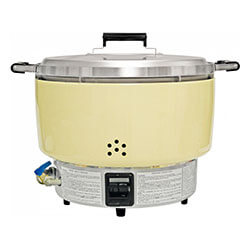
Gas rice cookers deliver high-BTU heat for rapid cooking and are preferred in high-volume Asian restaurants where speed and continuous production are critical. While electric models are more common, gas units are the workhorses behind busy sushi bars, dim sum houses, and Asian fusion restaurants that serve rice with nearly every dish. The direct flame heating provides faster cook times and quicker recovery between batches, critical when you're cooking 50+ batches per day. Gas also offers operational cost advantages in high-volume scenarios, as natural gas is typically less expensive per BTU than electricity. However, these benefits come with trade-offs: gas units require professional installation, a dedicated gas line, and proper ventilation, making them a bigger commitment than simply plugging in an electric model.
- Best For: High-volume Asian restaurants, banquet facilities, and kitchens already equipped with gas infrastructure.
- Key Features: 34,000-135,000 BTU burners, available in natural gas and propane configurations, extremely fast cook times.
- Pros: Fastest cooking speed, ideal for continuous batch production, lower operating cost in high-volume scenarios (gas is often cheaper than electricity per BTU).
- Cons: Requires gas line connection, needs proper ventilation, higher upfront cost, fewer models available compared to electric.
Gas Type Options
- Natural Gas: Connects to building gas supply; most common for permanent kitchen installations.
- Propane (LP): Uses portable tanks; suitable for operations without natural gas access or for mobile applications.
Important: Gas rice cookers require professional installation to connect to gas lines and must be placed under proper ventilation to exhaust combustion byproducts.
Types of Rice Cookers by Function
Beyond power source, rice cookers are categorized by what they do after cooking. This distinction is critical for matching equipment to your workflow.
Cook-Only (On/Off) Rice Cookers
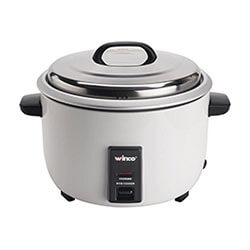
These basic models cook rice and then shut off. They do not maintain temperature after the cooking cycle completes. Think of them as single-purpose machines: you add rice and water, turn them on, and they cook until done; then stop. Without a warming function, the rice will begin cooling immediately after the cycle ends. This makes cook-only models best suited for operations with a clear workflow: cook the rice, transfer it immediately to a dedicated warmer or serving line, and repeat. They're the most affordable option and have fewer components that can fail, but they require more active management than cook-and-warm models.
- Best For: Operations that cook rice immediately before service and transfer it to separate holding equipment.
- How It Works: The heating element activates when turned on and shuts off automatically when the rice reaches the proper temperature (indicating doneness). There is no warming phase.
- Pros: Simplest design, lowest cost, fewer components to fail.
- Cons: Rice will cool and dry out if left in the unit; requires separate warmer or immediate service.
Cook-and-Warm Rice Cookers
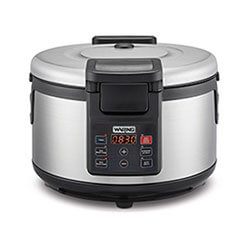
The most popular category for commercial use. These units cook rice and then automatically switch to a low-heat warming mode to maintain serving temperature. This "set it and forget it" functionality is why cook-and-warm models dominate commercial kitchens, you can prepare rice hours before service, and it will be ready and waiting at the perfect temperature when orders start coming in. The warming mode uses significantly less energy than the cooking phase, maintaining a safe holding temperature (typically 140°F or above) without continuing to cook or dry out the rice. For most restaurants, cafeterias, and foodservice operations, a cook-and-warm model eliminates the need for separate cooking and holding equipment, saving both counter space and equipment costs.
- Best For: Most restaurants, cafeterias, and any operation where rice is cooked in advance and held for extended service periods.
- How It Works: After the cooking cycle completes, the unit automatically transitions to a lower-wattage warming mode. This keeps rice at safe serving temperature (typically 140°F+) without continuing to cook it.
- Warming Duration: Standard models hold rice for 4-6 hours; extended-warming models can maintain quality for 8-12+ hours.
- Pros: All-in-one solution, reduces equipment footprint, maintains food safety temperatures automatically.
- Cons: Extended holding (beyond recommended time) can dry out rice or affect texture.
Warmers Only (Rice Warmers)
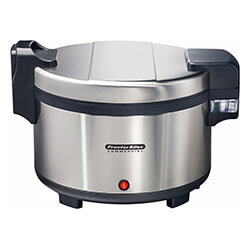
These units do not cook rice, they only hold pre-cooked rice at serving temperature. Rice warmers are purpose-built holding equipment designed for operations that have separated their cooking and holding functions. In high-volume kitchens, this separation makes sense: you might cook rice in large batches using a tilting skillet, steam-jacketed kettle, or multiple dedicated cookers, then transfer it to warmers positioned on the serving line. This approach maximizes throughput because your cooking equipment is never tied up holding finished product. Rice warmers typically offer larger holding capacities than cook-and-warm units and are optimized for maintaining temperature and moisture over extended periods without the cooking components that add cost and complexity.
- Best For: High-volume operations that cook rice in large batches using separate equipment (such as tilting skillets or steam-jacketed kettles) and need dedicated holding capacity.
- How It Works: Low-wattage heating elements maintain a consistent temperature to keep rice warm and ready to serve.
- Pros: Purpose-built for holding, often larger capacity than cook-and-warm units, frees up cookers for continuous batch production.
- Cons: Requires separate cooking equipment; does not cook rice.
Sushi Rice Containers
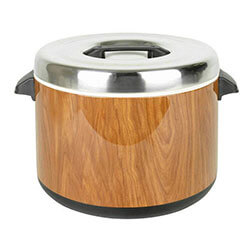
Specialized holding containers designed specifically for sushi rice (seasoned, vinegared rice). These maintain the precise temperature and humidity that sushi rice requires. Unlike standard rice warmers that keep rice hot, sushi rice containers are engineered to hold rice at room temperature - typically around 70-80°F - which is essential for proper sushi preparation. Hot rice would warm the fish and compromise food safety, while cold rice becomes hard and loses its sticky texture. Traditional sushi rice containers (hangiri) are made of cypress wood, which naturally absorbs excess moisture and imparts a subtle flavor. Modern commercial versions often use insulated plastic or stainless steel with humidity controls to replicate these properties while meeting health code requirements for easy cleaning and sanitation.
- Best For: Sushi restaurants and Japanese cuisine operations.
- Key Features: Wooden or insulated construction, humidity control, designed to keep rice at room temperature (not hot) to maintain proper sushi texture.
- Pros: Purpose-built for sushi rice quality, maintains ideal texture for hand-forming, traditional wooden versions enhance flavor.
- Cons: Not suitable for other rice applications; wooden versions require special care and seasoning.
Commercial vs. Residential Rice Cookers
While residential rice cookers are popular home appliances, they are not designed for the demands of a professional kitchen. Understanding the differences is critical for compliance, performance, and longevity.
| Feature: | Commercial Rice Cookers: | Residential Rice Cookers: |
| Capacity | 12-150+ cups uncooked; designed for batch production | 3-10 cups uncooked; designed for family meals |
| Certification | NSF/UL Commercial: Meets strict sanitation and safety codes for foodservice use | Consumer UL: Not certified for commercial kitchens; will fail health inspections |
| Construction | Heavy-gauge stainless steel housing; reinforced heating elements; commercial-grade thermostats | Plastic housing; lighter components; consumer-grade internals |
| Duty Cycle | Built for continuous daily use (10-50+ batches per day) | Built for occasional use (1-3 batches per day) |
| Recovery Time | Fast recovery between batches; heavy-duty elements maintain consistent performance | Slower recovery; elements not designed for back-to-back cooking |
| Inner Pan | Thick, commercial-grade non-stick or stainless steel; replaceable | Thinner non-stick coating; often not replaceable |
| Warranty | Commercial warranty covers business use | Residential warranty voided if used commercially |
Why You Cannot Use a Home Rice Cooker in a Commercial Kitchen:
Beyond durability concerns, using a residential rice cooker in a commercial setting typically violates local health codes. Commercial kitchens require NSF-certified equipment that meets sanitation standards for food contact surfaces, cleanability, and safe operation. Residential units lack this certification. Additionally, using non-commercial equipment can invalidate your business insurance and create liability issues if food safety problems arise. The small upfront savings of a home unit will cost far more in failed inspections, equipment replacement, and potential health code violations.
Understanding Capacity: Uncooked vs. Cooked
One of the most common mistakes buyers make is confusing uncooked capacity with cooked capacity. These are two different measurements, and misunderstanding them leads to undersized (or oversized) equipment purchases.
The 2:1 Rule
Rice approximately doubles in volume when cooked. This means:
| Uncooked Capacity: | Cooked Capacity (Approximate): |
| 12 cups | 24 cups |
| 25 cups | 50 cups |
| 30 cups | 60 cups |
| 50 cups | 100 cups |
| 90 cups | 180 cups |
How Manufacturers Label Capacity
- Uncooked Capacity: The amount of dry, uncooked rice the unit can hold. This is the input measurement.
- Cooked Capacity: The amount of finished, cooked rice the unit produces. This is the output measurement.
Some manufacturers list uncooked capacity, others list cooked capacity, and some list both. Always verify which measurement is being used before purchasing.
Example: A rice cooker rated at "60 cups" could mean 60 cups uncooked (producing 120 cups cooked) OR 60 cups cooked (requiring only 30 cups uncooked). That's a 2x difference in actual output.
Sizing by Operation Type
| Operation Type: | Daily Rice Volume: | Recommended Uncooked Capacity: |
| Small café / food truck | 20-50 cups cooked | 12-25 cups uncooked |
| Casual dining restaurant | 50-150 cups cooked | 25-50 cups uncooked |
| High-volume Asian restaurant | 150-400 cups cooked | 50-90 cups uncooked (or multiple units) |
| Cafeteria / institutional | 200-500+ cups cooked | 90-150 cups uncooked (or multiple units) |
| Banquet / catering | Variable, high peaks | Multiple units or gas for speed |
Capacity Planning Tips
- Calculate Peak Demand: How many rice servings do you need during your busiest hour? A typical rice serving is 1/2 to 1 cup cooked.
- Factor Cook Time: Electric rice cookers take 20-40 minutes per batch. Gas units are faster (15-25 minutes). Can you cook enough batches to meet demand?
- Consider Holding Time: If you use a cook-and-warm model, you can prepare rice before the rush and hold it.
- Size Up: It's better to have slightly more capacity than you need. An undersized cooker forces multiple small batches, increasing labor and inconsistency.
Features & Accessories
Essential Features
- Non-Stick Inner Pan: Dramatically reduces cleaning time and prevents rice from sticking and burning. Essential for busy kitchens.
- Keep-Warm Function: Automatically maintains serving temperature after cooking. Standard on cook-and-warm models.
- Indicator Lights: Shows cooking vs. warming status at a glance.
- Removable Lid: Allows easy cleaning and inspection during cooking.
Valuable Add-Ons
- Steamer Tray: Fits inside the cooker to steam vegetables or dumplings simultaneously while rice cooks below. Maximizes equipment utility.
- Quick Cook Mode: Skips the soak/preheat phase for faster cooking when time is critical. Slightly affects texture but saves 10-15 minutes.
- Extended Warm Timer: Some models can hold rice at quality for 12+ hours, ideal for all-day service.
Accessories
- Measuring Cups: Commercial rice cookers use specific measuring cups (often 180ml, not standard 8oz cups). Always use the cup provided with the unit.
- Rice Paddles: Wide, flat paddles for fluffing and serving without damaging grains.
- Replacement Inner Pans: Non-stick coatings wear over time. Having a spare pan prevents downtime.
Installation & Maintenance
Installation Requirements
Electric Units
- 120V Models: Standard 15A or 20A outlet; no special installation required.
- 208V/240V Models: Requires dedicated circuit and appropriate outlet; may need electrician for installation.
- Placement: Keep away from water sources; ensure adequate countertop space for ventilation.
Gas Units
- Gas Connection: Must be installed by a licensed professional; requires appropriate gas line and shutoff valve.
- Ventilation: Must be placed under a Type 1 hood or in a well-ventilated area to exhaust combustion gases.
- Clearance: Follow manufacturer specifications for clearance from walls and combustibles.
Daily Maintenance
- Clean Inner Pan: Wash the removable inner pan after each use. For non-stick pans, use soft sponges only, no abrasive scrubbers.
- Wipe Exterior: Clean the outer housing and control panel with a damp cloth.
- Check Lid Seal: Ensure the lid gasket (if equipped) is clean and seating properly for efficient cooking.
- Empty Condensation: Some models collect condensation in a tray; empty daily.
Periodic Maintenance
- Inspect Heating Element: Visually check for buildup or damage monthly.
- Deep Clean: Remove and clean all removable parts weekly; check for rice residue in crevices.
- Replace Non-Stick Pan: When the coating shows significant wear or scratching, replace the inner pan to maintain performance and food safety.
Tips for Perfect Rice
Follow these best practices to ensure consistent, high-quality rice every time.
Before Cooking
- Rinse Your Rice: Rinsing removes surface starch and debris, resulting in fluffier, less sticky grains. Place rice in a fine-mesh strainer and rinse under cold water until the water runs mostly clear (1-2 minutes).
- Check for Enriched Rice: Some rice varieties are enriched with water-soluble vitamins and minerals (iron, thiamin, folic acid) that dissolve when rinsed. Always check packaging; if it says "enriched," skip the rinse or you'll wash away the added nutrients.
- Use the Right Measuring Cup: Commercial rice cookers include a specific measuring cup (typically 180ml or 6oz, not the standard 8oz US cup). Always use the cup that came with your unit, as water-to-rice ratios are calibrated to that measurement.
- Follow Water Ratios: The standard ratio is approximately 1.5 cups water per 1 cup of rinsed white rice, but this varies by rice type. Brown rice and wild rice require more water and longer cook times.
During Cooking
- Never Open the Lid: Opening the lid during cooking releases steam and disrupts the cooking process. Trust the thermostat, the cooker knows when the rice is done.
- Don't Stir: Stirring rice during cooking breaks the grains and releases starch, resulting in gummy, sticky rice.
After Cooking
- Let It Rest: When the cooking cycle completes, let the rice rest undisturbed for 5-10 minutes before opening the lid. This allows residual steam to finish the cooking process and makes for fluffier results.
- Fluff Gently: Use a rice paddle or plastic fork to gently fluff the rice, separating the grains. Avoid metal utensils on non-stick pans.
- Serve or Hold Promptly: Transfer to a warmer or begin service. If using a cook-and-warm model, the unit will maintain safe temperature automatically.
Flavor Enhancements
For added flavor, consider cooking rice with:
- A pinch of salt
- A tablespoon of butter or oil
- Chicken, vegetable, or beef broth instead of water
- Aromatics like bay leaves, garlic, or ginger
These can be added directly to the cooker before the cooking cycle begins.
Frequently Asked Questions
What is the difference between uncooked and cooked capacity?
Uncooked capacity refers to dry rice before cooking; cooked capacity is the finished output. Rice roughly doubles in volume when cooked, so a 30-cup (uncooked) rice cooker produces approximately 60 cups of cooked rice.
Should I choose electric or gas?
Electric is best for most operations; it's easier to install, more widely available, and sufficient for typical restaurant volumes. Choose gas if you need maximum speed for very high-volume continuous production and already have gas infrastructure.
How long can I hold rice in a cook-and-warm unit?
Most manufacturers recommend holding rice for 4-6 hours maximum for optimal texture and quality. Extended-warming models can hold for 8-12 hours, but quality gradually declines. For food safety, rice must be held at 140°F or above.
Do I need a separate rice warmer?
Only if you cook rice in bulk using other equipment (like tilting skillets) and need dedicated holding capacity. For most operations, a cook-and-warm rice cooker handles both functions.
What size rice cooker do I need for a busy restaurant?
Calculate your peak hourly demand in cooked cups, then work backward using the 2:1 ratio. A restaurant serving 100 rice portions per hour (at 3/4 cup each = 75 cooked cups) would need at least a 40-cup uncooked capacity cooker, assuming one batch per hour plus some holding time.
Can I cook other grains in a rice cooker?
Yes. Commercial rice cookers can prepare oatmeal, quinoa, barley, and other grains. Some operations also use them for steaming vegetables (with a steamer tray) or preparing hot cereals. Adjust water ratios and cooking times per grain type.
Why is my rice cooker producing inconsistent results?
Common causes include: incorrect water-to-rice ratio, using the wrong measuring cup, overfilling beyond capacity, opening the lid during cooking (releases steam), or a failing heating element. Always use the measuring cup provided with the unit.
Do commercial rice cookers require a hood?
Electric rice cookers do not require ventilation hoods. Gas rice cookers must be placed under a Type 1 hood or in a properly ventilated area due to combustion exhaust.
How do I prevent rice from sticking?
Use a non-stick inner pan, follow the correct water ratio, and avoid disturbing the rice during cooking. Let it rest for 5-10 minutes after the cook cycle completes before opening the lid. Fluff gently with a rice paddle before serving.
What's the difference between a rice cooker and a rice warmer?
A rice cooker cooks raw rice; a rice warmer only holds pre-cooked rice at serving temperature. Cook-and-warm models do both; they cook rice and then automatically switch to warming mode.
Shop Rice Cookers
- Commercial Rice Cookers - Browse all rice cookers and warmers
- Electric Rice Cookers - Plug-and-play models for most kitchens
- Gas Rice Cookers - High-BTU options for maximum speed
- Rice Cookers & Warmers - All-in-one cook and hold solutions
Shop Rice Serving Bowls
- Porcelain Rice Bowls - Classic, durable bowls for upscale dining
- Melamine Rice Bowls - Break-resistant options for high-volume service
- Stoneware Rice Bowls - Rustic, artisan-style presentation
Related Guides
- Commercial Steamer Guide - Steam cooking for vegetables, seafood, and more
- Commercial Cooking Equipment Guide - Overview of all cooking equipment categories
Share This!