Restaurant Traditional Media Advertising Guide
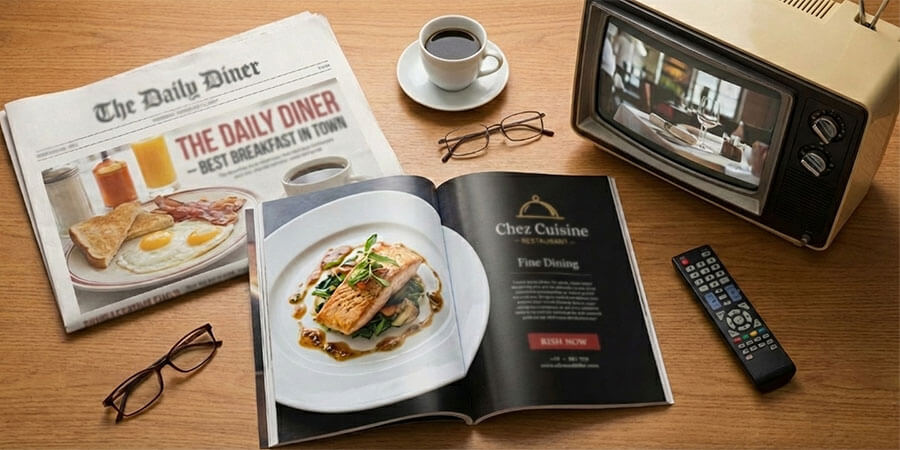
Table of Contents
Proven strategies to reach local customers through print advertising, radio spots, and television commercials
Traditional media - print, radio, and television - remains highly effective for restaurant marketing. Radio delivers the highest advertising ROI at $12 return for every $1 spent, while local TV and community publications build credibility and reach audiences in ways digital cannot replicate. This guide covers how to leverage newspapers, magazines, radio, and TV (including connected TV) to drive customers to your restaurant.
Despite the digital marketing boom, traditional media channels continue delivering strong results for restaurants. While social media and online advertising dominate marketing conversations, savvy restaurant owners know that print, radio, and television advertising reach audiences that digital often misses - and frequently with higher trust and engagement.
The numbers back this up. Radio advertising generates an average $12 return for every $1 spent, making it the highest-ROI advertising medium available. Local television builds brand credibility that digital ads struggle to match. And print advertising in community publications reaches loyal local audiences who actively engage with their neighborhood news.
This guide covers how to effectively use each traditional media channel - from local newspaper ads to streaming TV spots - to bring more customers through your doors.
Why Traditional Media Still Works for Restaurants
Traditional media offers distinct advantages that complement digital marketing efforts:
Local targeting precision - Traditional media excels at reaching specific geographic areas. A radio spot on your local station or an ad in your community newspaper reaches exactly the people who can actually visit your restaurant - not a global audience that will never walk through your doors.
Higher trust levels - Consumers consistently trust traditional media advertising more than digital ads. Print ads in established publications and spots on familiar radio stations carry credibility that banner ads and social posts often lack.
Reaching unreachable audiences - Not everyone lives online. Traditional media reaches older demographics, busy professionals who avoid social media, and consumers who tune out digital advertising. Radio, in particular, captures commuters during drive time when they are often thinking about their next meal.
Cutting through digital fatigue - After years of constant digital bombardment, many consumers now pay more attention to traditional advertising. A well-designed print ad or memorable radio jingle stands out precisely because it is not another pop-up or sponsored post.
Multi-sensory engagement - Television and radio engage audiences through sight, sound, and storytelling in ways that static digital ads cannot match. The sizzle of a steak, the crunch of fresh vegetables, the warmth of a family gathering - traditional media brings these to life.
Print Advertising - Newspapers and Magazines
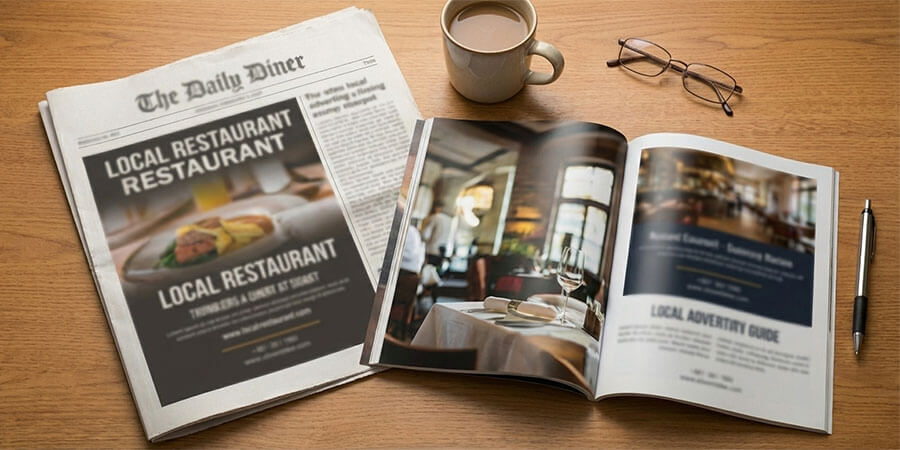
Print advertising provides restaurants with tangible, trustworthy placements that readers actively engage with - unlike digital ads that users often scroll past or block entirely.
Local Newspapers
Local newspapers remain valuable advertising partners for restaurants, particularly for reaching established community members and promoting special events or announcements.
Effective newspaper advertising strategies:
- Restaurant section placement - Most local papers have dining or entertainment sections where restaurant ads perform best. Readers browsing these sections are actively looking for dining options.
- Event and promotion announcements - Grand openings, anniversary celebrations, holiday specials, and seasonal menu launches all make compelling newspaper advertising content.
- Coupon integration - Newspaper coupons still drive restaurant traffic, particularly among value-conscious diners. Track redemption rates to measure effectiveness.
- Advertorial content - Some newspapers offer paid content opportunities where you can share your restaurant's story, chef profiles, or signature dish features in an editorial format.
Newspaper advertising considerations:
Print readership skews older, with strongest reach among audiences 45 and above. This makes newspaper advertising particularly effective for fine dining establishments, family restaurants, and concepts targeting mature diners. For restaurants primarily targeting younger demographics, other channels may prove more effective.
Community Publications and Magazines
Hyperlocal publications - neighborhood newsletters, chamber of commerce magazines, community event guides, and regional lifestyle magazines - offer highly targeted reach to engaged local audiences.
Why community publications work:
- Readers have chosen to engage with local content, indicating community investment
- Longer shelf life than newspapers - magazines sit on coffee tables for weeks
- Less advertising clutter means your ad gets more attention
- Often more affordable than major daily newspapers
Types of community publications to consider:
- Chamber of commerce newsletters and magazines
- Neighborhood association publications
- Local parent and family magazines
- Regional lifestyle and entertainment guides
- Community event programs and directories
- Tourism and visitor guides (valuable if you are in a tourist area)
Best Practices for Print Advertising
Design for impact:
- Use high-quality food photography - appetizing images drive response
- Keep text minimal and readable - your ad competes with editorial content
- Include clear contact information and location details
- Feature a specific offer or call to action, not just general branding
Integrate print with digital:
The most effective modern print ads connect to digital experiences. Include QR codes linking to your menu, reservation system, or special landing page. This "phygital" approach combines print's credibility with digital's convenience and lets you track response rates.
Test and measure:
- Use unique coupon codes or mention requirements to track responses
- Ask new customers how they heard about you
- Compare response rates across different publications
- Track timing - some publications perform better around holidays or events
Radio Advertising
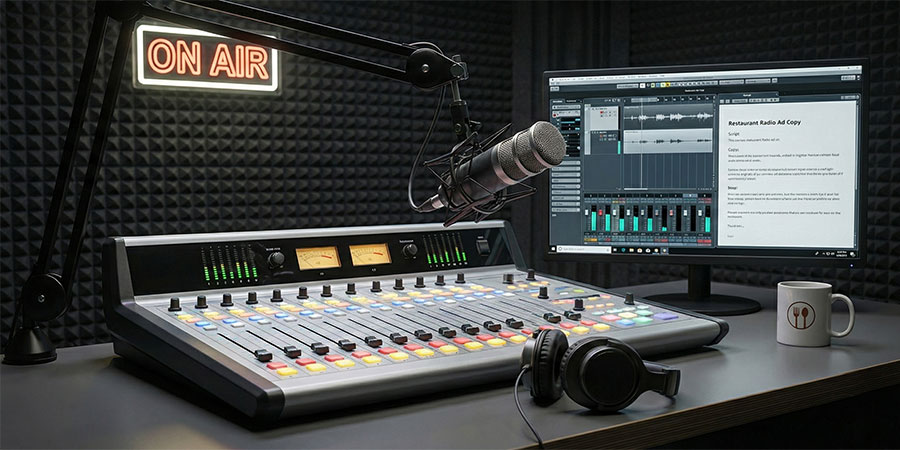
Radio advertising deserves serious consideration from restaurant marketers - it delivers the highest return on investment of any advertising medium, generating an average $12 return for every $1 spent according to Nielsen research.
Why Radio Works for Restaurants
Massive reach - Radio reaches 90% of American adults weekly, with listeners tuning in for an average of 102 minutes per day. No other medium matches this combination of reach and engagement time.
Capturing meal decisions - 89% of consumers make last-minute meal decisions, and many of these decisions happen during commute time when radio dominates attention. A well-timed radio spot can directly influence where someone stops for lunch or picks up dinner.
Drive-time advantage - Morning and evening commute hours represent prime opportunities for restaurant advertising. Listeners are in their cars, often hungry, and thinking about their next meal. Radio owns this audience in ways no other medium can match.
Trust and familiarity - 69% of radio listeners report trusting the advertising they hear on their favorite stations. Familiar voices, local personalities, and consistent presence build credibility over time.
Cost-effective frequency - Radio allows restaurants to build advertising frequency - the repetition necessary for message retention - at costs significantly lower than television.
Types of Radio Advertising
Spot advertising - Traditional 15, 30, or 60-second commercials that air during commercial breaks. These can be produced professionally or recorded at the station.
Live reads and endorsements - Local radio personalities read your advertising copy live on air, often adding personal recommendations. These endorsements carry significant credibility with loyal listeners.
Sponsorships - Sponsor traffic reports, weather updates, or popular show segments for consistent brand exposure. "Lunch traffic brought to you by [Your Restaurant]" keeps your name top-of-mind at meal times.
Remote broadcasts - Radio stations broadcast live from your restaurant during special events, driving immediate traffic while creating buzz. Grand openings, anniversary celebrations, and community events work well for remotes.
Digital audio - Many radio stations now offer streaming inventory alongside traditional broadcast. This allows geographic targeting and reaches younger audiences who consume radio through apps and smart speakers.
Creating Effective Radio Spots
Focus on one clear message - Radio listeners cannot replay your ad. Focus on a single offer, event, or brand message rather than trying to communicate everything about your restaurant.
Use sound strategically - The sizzle of cooking, clinking glasses, happy conversation, and appetizing descriptions engage listeners' imaginations. Radio's "theater of the mind" can be more powerful than visual advertising.
Include clear calls to action - Tell listeners exactly what to do - visit for lunch today, call to make reservations, mention the ad for a discount. Make the action specific and immediate.
Repeat key information - Mention your restaurant name at least three times in a 30-second spot. Include your location in memorable terms ("right off exit 12" or "downtown on Main Street").
Match your audience - Different radio formats reach different demographics. Classic rock listeners differ from country music fans differ from talk radio audiences. Choose stations whose listeners match your target customers.
Television Advertising
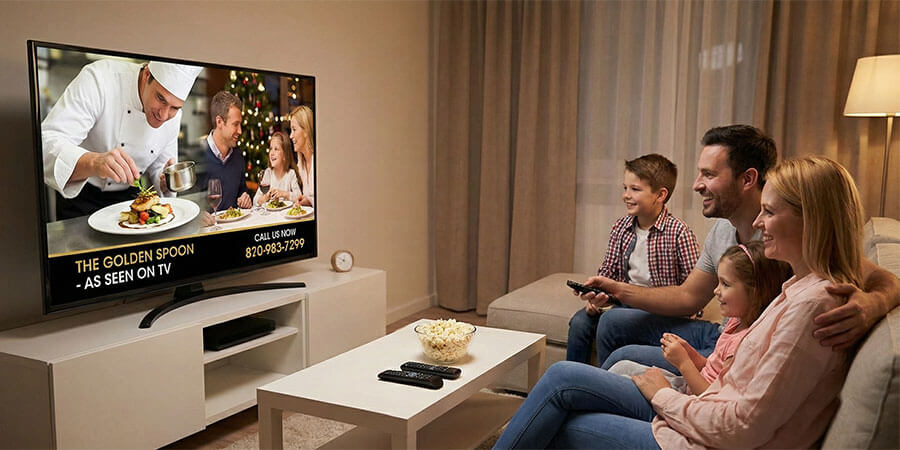
Television advertising builds brand credibility and awareness in ways that smaller-format advertising cannot match. While traditionally expensive, new options like connected TV (CTV) and streaming platforms have made television advertising accessible to restaurants of all sizes.
Local TV Spots
Local broadcast and cable television advertising remains effective for restaurants seeking broad community reach and brand-building.
When local TV makes sense:
- Multi-location restaurants needing broad market awareness
- Grand openings and major announcements
- Established restaurants reinforcing brand presence
- Special events expecting community-wide interest
- Restaurants targeting older demographics with higher TV viewership
Local TV advertising options:
- Broadcast spots - Traditional commercials during local news, sports, or entertainment programming
- Cable zone advertising - Target specific neighborhoods or zip codes through cable system zone buys
- News sponsorships - Sponsor weather, sports, or traffic segments for consistent visibility
- Community programming - Local access channels and community shows offer affordable exposure
Production considerations:
Television commercials require higher production quality than other formats. Poorly produced spots can damage brand perception. Work with experienced production companies or station production departments to create professional content. Many local stations offer production services as part of advertising packages.
Connected TV and Streaming
The television landscape has transformed dramatically. Streaming now commands more viewing time than traditional broadcast and cable combined. Connected TV (CTV) advertising - ads shown through streaming services on smart TVs, streaming devices, and gaming consoles - has opened television advertising to businesses previously priced out.
Why CTV matters for restaurants:
- Geographic precision - Target viewers within your delivery zone or within a specific drive radius of your location
- Audience targeting - Reach viewers based on demographics, interests, and behaviors, not just program selection
- Lower entry costs - Campaign minimums far below traditional TV, making television accessible to single-location restaurants
- Measurable results - Digital delivery allows tracking impressions, completion rates, and conversions
- Non-skippable formats - Many streaming ad formats cannot be skipped, ensuring message delivery
CTV advertising platforms:
- Self-service platforms - Services like Google DV360, The Trade Desk, and specialized restaurant advertising platforms allow direct CTV buying
- Streaming services - Hulu, Peacock, Paramount+, and other ad-supported streamers offer advertising inventory
- Local station streaming - Many local TV stations sell inventory on their streaming apps and websites
- Agency partnerships - Local advertising agencies can navigate CTV buying for restaurants new to the space
CTV creative considerations:
Streaming viewers expect high production quality. Repurpose existing quality video content or invest in professional production. Many restaurants successfully use the same creative across traditional TV and streaming, maximizing production investment.
Creating Effective TV Commercials
Show the food - Television is a visual medium. High-quality footage of your dishes being prepared and served drives appetite appeal. Invest in professional food videography.
Tell a story - The most memorable restaurant commercials tell brief stories - a family gathering, friends celebrating, a moment of satisfaction. Emotion drives action.
Keep it simple - A 30-second spot allows time for one main message. Do not try to show your entire menu or explain your full concept. Focus on what makes you worth visiting.
Brand consistently - Include your logo, colors, and restaurant atmosphere. Viewers should recognize your advertising as yours even before hearing your name.
End with clear information - Always close with your restaurant name, location, and the action you want viewers to take. A phone number or website should be visible long enough to note.
Creating Effective Traditional Media Advertising
Regardless of which traditional media channels you use, certain principles apply across all formats.
Design Principles
Prioritize food photography and imagery - In restaurant advertising, appetizing visuals sell. Invest in professional food photography that showcases your dishes at their best. Avoid stock photography that could represent any restaurant.
Maintain brand consistency - Use consistent colors, fonts, logos, and visual style across all advertising. Customers should recognize your ads before reading a word. This consistency builds brand equity over time.
Embrace white space - Cluttered ads get ignored. Give your message room to breathe. A single powerful image with minimal text often outperforms busy designs trying to communicate everything.
Design for the medium - A newspaper ad, radio spot, and TV commercial require different approaches. Design specifically for each medium's strengths rather than forcing one concept across all channels.
Messaging Strategies
Lead with your differentiator - What makes your restaurant worth visiting over competitors? Lead with that distinction - whether it is your signature dish, unique atmosphere, exceptional value, or convenient location.
Create urgency when appropriate - Limited-time offers, seasonal specials, and event announcements give audiences reason to act now rather than "someday." Balance urgency messaging with evergreen brand building.
Address customer motivations - People choose restaurants for many reasons - convenience, celebration, family time, date nights, quick lunches, special dietary needs. Speak to the specific motivation that matches your concept.
Keep copy conversational - Write like you speak. Formal or corporate-sounding advertising creates distance. Friendly, conversational copy invites engagement.
Calls to Action
Every advertisement needs a clear call to action - what do you want the audience to do?
Effective restaurant CTAs:
- Visit us today for lunch
- Call now to reserve your table
- Stop by this weekend for our special
- Mention this ad for a free appetizer
- Scan the QR code to see our menu
- Join us for [specific event]
Make your CTA specific, immediate, and achievable. "Visit soon" is weaker than "Join us for dinner tonight."
Measuring ROI on Traditional Media
Traditional media measurement differs from digital advertising's precise tracking, but effective measurement is absolutely possible.
Tracking Methods
Unique offers - Create codes, coupons, or mention requirements specific to each advertising channel. "Mention you heard us on WXYZ for a free dessert" lets you count responses exactly.
Ask every customer - Train staff to ask new customers how they heard about you. Track responses consistently over time to identify which channels drive traffic.
Pre and post measurement - Compare traffic, sales, and new customer counts during advertising campaigns versus baseline periods. Account for seasonality and other variables.
Phone and web tracking - Use unique phone numbers or landing pages for different advertising campaigns to track direct response.
Reservation source tracking - If you take reservations, ask how guests heard about you during the booking process.
Setting Expectations
Traditional media typically builds awareness and consideration over time rather than driving immediate clicks. Evaluate traditional advertising on:
- Brand awareness lift in your market
- New customer acquisition over campaign duration
- Overall traffic and sales trends during advertising periods
- Qualitative feedback from new customers about how they found you
Expect traditional media campaigns to require consistent presence over months rather than delivering instant results. Frequency builds recognition and trust.
Combining Traditional and Digital Marketing
The most effective restaurant marketing strategies integrate traditional and digital channels rather than treating them as separate efforts.
The Phygital Approach
"Phygital" marketing bridges physical and digital experiences:
- QR codes in print ads link to menus, reservations, or special offers
- Social media mentions in radio spots drive followers and engagement
- TV commercials promoting hashtags extend campaigns into social conversation
- Print coupons redeemable online track offline-to-online conversion
Cross-Channel Consistency
Ensure your messaging stays consistent across all channels:
- Same offers, same timing, same visual identity
- Traditional advertising supports digital campaigns and vice versa
- In-store experience matches advertising promises
- Staff knows current promotions across all channels
Budget Allocation
There is no universal formula for balancing traditional and digital spending. Consider:
- Your target audience's media consumption habits
- Your competitive landscape and what competitors are doing
- Your marketing objectives (awareness versus direct response)
- Your creative assets and production capabilities
- Testing results from different channel combinations
Many restaurants find success with 60-70% digital and 30-40% traditional, but optimal allocation varies significantly by concept, market, and objectives.
Frequently Asked Questions
Which traditional media channel offers the best ROI for restaurants?
Radio advertising consistently delivers the highest measurable ROI, averaging $12 return for every $1 spent according to Nielsen research. Radio's combination of broad reach, drive-time dominance, and relatively low costs makes it particularly effective for restaurant advertising. However, optimal channel selection depends on your specific target audience and market.
How much should a restaurant spend on traditional media advertising?
Most restaurant marketing guidelines suggest allocating 3-6% of revenue to total marketing, with traditional media representing a portion of that budget. For a restaurant with $1 million annual revenue, this might mean $30,000-$60,000 total marketing budget annually. Start with what you can afford consistently - sporadic advertising is less effective than steady presence.
Is print advertising still worth the investment in 2025 and beyond?
Print advertising remains valuable for reaching specific audiences - particularly older demographics and engaged community members. While overall print circulation has declined, remaining readers are often highly engaged. Community publications, in particular, offer strong local targeting at reasonable costs. The key is selecting publications whose readership matches your target customers.
How do I get started with connected TV advertising?
Several self-service platforms make CTV advertising accessible to restaurants. Services like Google's advertising platform, specialized restaurant advertising technology companies, and streaming services with ad-supported tiers all offer entry points. Start with a modest test budget, use existing video content if available, and target tightly around your restaurant's location.
What makes a radio ad effective for restaurants?
Effective restaurant radio ads focus on a single clear message, use sound to create appetite appeal (sizzling, cooking sounds, enthusiastic voices), repeat the restaurant name and location multiple times, and include a specific call to action. Live reads from popular local personalities often outperform produced spots because they carry the credibility of personal endorsement.
How long should I run a traditional media campaign to see results?
Traditional media requires consistency to build awareness and drive action. Plan for minimum 8-12 week campaigns to establish presence and build frequency. Short bursts may generate some response but rarely build lasting awareness. Many successful restaurants maintain year-round presence at varying intensity levels rather than running occasional campaigns.
Should I produce my own advertising or use station/publication services?
It depends on the medium and your resources. For radio, station-produced spots and live reads often perform well. For television, professional production is essential - poorly produced TV commercials can damage brand perception. For print, publications often offer design services, but consider professional design if your budget allows. Quality matters more than production source.
How do I know if my traditional advertising is working?
Use multiple measurement approaches - unique offer codes, new customer source tracking, comparing sales during campaign versus baseline periods, and qualitative feedback. Accept that traditional media measurement is less precise than digital but still valuable. Look for trends over time rather than expecting exact attribution for every customer.
Related Resources
- Restaurant Offline Marketing Guide - Comprehensive coverage of non-digital marketing tactics including direct mail, community events, and local partnerships
- Restaurant Marketing for New Owners - Foundation marketing strategies for restaurant owners just getting started
- Restaurant Guerrilla Marketing Guide - Creative, low-cost marketing tactics that generate attention and word-of-mouth
- Restaurant Menu Design Guide - Design principles that apply to advertising creative as well as menus
Share This!