Restaurant Coupons and Promotions Guide
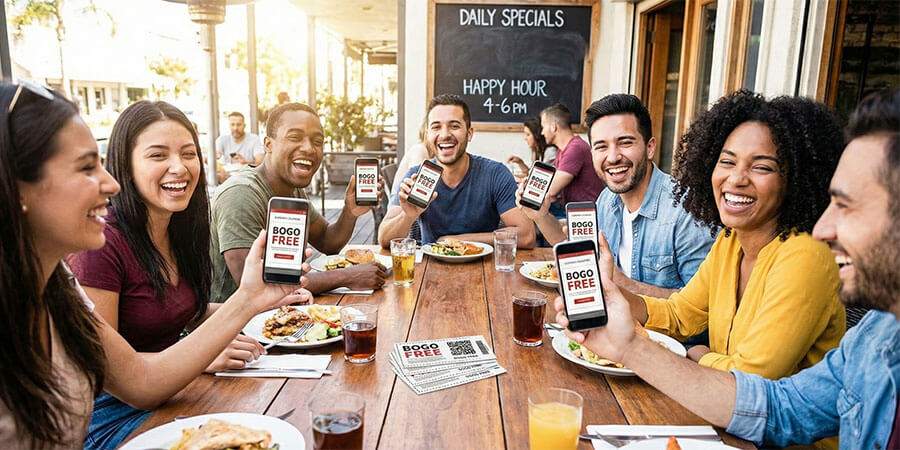
Table of Contents
How to use coupons and promotions to fill seats, attract first-time guests, and build long-term restaurant loyalty
Deal-seeking among restaurant customers has reached its highest level in 50 years, with 29% of all commercial foodservice traffic now happening on a deal. For restaurant operators, promotions are no longer optional - they are a core part of how guests make dining decisions. This guide covers the most effective promotion types, how to structure offers that protect your margins, when to time promotions for maximum impact, how to avoid the discount dependency trap, and how to measure whether your promotions are actually driving profitable growth.
Promotions have always been part of the restaurant business - happy hours, daily specials, and loyalty punch cards have existed for decades. What has changed is the intensity of consumer deal-seeking and the tools available to deliver targeted offers.
According to Circana's 2025 analysis of 50 years of U.S. foodservice data, 29% of all commercial restaurant traffic over the past 12 months involved a deal - the highest rate in the firm's entire tracking history. Deal-driven traffic has climbed 3.1 percentage points since 2022, a surge not seen since the 2008-2010 financial crisis. Separately, a December 2025 report from Savings.com found that 82% of consumers say coupons and discounts help them cope with high prices, and 46% now view coupons as a necessity rather than a perk.
For restaurants, this shift is both an opportunity and a risk. Done well, promotions attract new customers, fill slow periods, and build loyalty. Done poorly, they train customers to wait for deals, erode already thin margins, and attract one-time visitors who never return at full price. This guide focuses on getting the balance right.
Why Promotions Work for Restaurants
The core logic behind restaurant promotions is simple: lower the barrier for a first visit, then let the food and experience earn the repeat. The data supports this approach - but only when the execution is disciplined.
Promotions drive trial. Capital One Shopping's 2026 research found that 86% of consumers are more likely to try a new business when offered a coupon, and 58% of shoppers say a good coupon would make them try a brand they have never visited before - up from 49% in 2023 according to Savings.com. For restaurants specifically, this means a well-targeted promotion can reach people who drive past your location every day but have never had a reason to stop in.
Repeat customers are where the real value lives. Data from Olo's analysis of more than 100 million guest records found that 60% of restaurant revenue comes from repeat guests. Bloom Intelligence's 2026 analysis across more than 1,000 restaurant locations found that guests who do return average 6.93 total visits and are worth 26 times more than one-time visitors. The challenge is that 77% of first-time restaurant guests never come back - which means every promotion needs a strategy for converting trial into loyalty, not just driving a single discounted visit.
The math favors retention. Research from Bain and Company has consistently shown that increasing customer retention by just 5% can boost profits by 25% to 95%. Customers enrolled in restaurant loyalty programs spend 12-18% more than unenrolled customers according to Capital One Shopping's 2025 report. The most effective promotions are designed with this retention math in mind - the initial offer is an investment in a relationship, not a giveaway.
| Metric: | Finding: | Source: |
| Restaurant traffic on a deal | 29% - highest in 50 years of tracking | Circana 2025 |
| Consumers more likely to try new business with coupon | 86% | Capital One Shopping 2026 |
| Consumers who tried new brand due to coupon (up from 49% in 2023) | 58% | Savings.com December 2025 |
| Restaurant revenue from repeat guests | 60% | Olo 2024 (100M+ guest records) |
| First-time guests who never return | 77% | Bloom Intelligence 2026 |
| Returning guests' value vs. one-time visitors | 26x more valuable | Bloom Intelligence 2026 |
| Retention increase needed to boost profits 25-95% | 5% | Bain and Company |
Types of Restaurant Promotions
Not every promotion works the same way. The right type depends on what you are trying to accomplish - attracting new customers, filling slow periods, increasing average check size, or rewarding loyal guests.
Buy-one-get-one (BOGO) offers are among the most recognized promotion formats. Capital One Shopping's 2025 research found that 93% of American consumers have used a BOGO deal at least once, and 49% would visit a competitor for a BOGO offer. For restaurants, BOGO works best on items with lower food costs - appetizers, desserts, or drinks - where the incremental cost of the free item is manageable and the promotion encourages bringing a friend.
Percentage-off discounts give customers a straightforward savings incentive. These work well for first-time visitor offers, slow-day promotions, or email and text marketing campaigns. The key is setting the discount percentage at a level that still allows reasonable margins - typically 10-20% for most restaurant formats.
Happy hour pricing targets specific dayparts when your restaurant would otherwise have empty seats. PepsiCo Partners' 2025 research found that 40% of consumers attend happy hour weekly, and nearly 75% plan to continue or increase their visits. Happy hour is particularly effective for restaurants with beverage programs because drinks typically carry higher margins than food, allowing deeper discounts while remaining profitable.
Limited-time offers (LTOs) create urgency that drives immediate action. Technomic's January 2026 data shows that LTOs across the restaurant industry increased 19% year-over-year, with restaurants leaning heavily into this format to generate excitement without permanently lowering prices. LTOs work because scarcity motivates behavior - customers visit sooner because they know the offer will disappear.
Kids-eat-free promotions target families - one of the highest lifetime-value customer segments for restaurants. These promotions typically require an adult purchase and are offered on specific days of the week, filling slower weeknight periods while attracting multi-person parties with higher total checks.
Loyalty-linked offers reward repeat behavior rather than discounting indiscriminately. Data from Paytronix's 2024 report found that top-performing operators drive 30-37% of all transactions through loyalty program members. Tying promotions to loyalty enrollment ensures you capture customer data while building a relationship, rather than offering a one-time discount to someone you may never see again.
Combo and bundle deals increase average check size by packaging multiple items at a perceived discount. The customer feels they are getting value, while the restaurant moves more items per transaction and can strategically include higher-margin components in the bundle.
| Promotion Type: | Best For: | Key Consideration: |
| BOGO | Bringing in pairs, trial | Use on lower food-cost items to protect margins |
| Percentage off | First-time visitors, slow days | Keep discounts at 10-20% for sustainable margins |
| Happy hour | Filling slow dayparts | Higher drink margins allow deeper discounts |
| Limited-time offers | Creating urgency, seasonal items | Set firm end dates - no extensions |
| Kids eat free | Attracting families on slow nights | Require adult purchase, limit to specific days |
| Loyalty-linked offers | Rewarding repeat customers | Captures data and builds long-term relationships |
| Combo and bundle deals | Increasing average check size | Include higher-margin items in bundles |
Designing Promotions That Protect Your Margins
The average restaurant operates on a 3-5% profit margin. A poorly structured promotion can easily wipe out that margin entirely - or worse, create losses on every discounted transaction. Smart promotion design starts with understanding your costs.
Know your food cost on every promoted item. Before offering any discount, calculate the food cost percentage of each menu item involved. Promote items where your food cost is already low - beverages, appetizers, and desserts typically offer more room for discounting than entrees with expensive proteins.
Set minimum purchase requirements. Requiring a minimum spend or specific purchase alongside the promotion ensures the discounted item is offset by full-price revenue. A free appetizer with the purchase of two entrees, for example, adds incremental cost but drives higher total checks.
Limit promotional windows. Restrict offers to specific days, dayparts, or a defined number of uses. This prevents the promotion from cannibalizing full-price sales during your busiest periods. Happy hour pricing during your slowest three hours is a different financial equation than offering the same discount all day.
Calculate breakeven before launching. Determine how many additional customers or higher average checks you need to offset the discount. If a 15% discount requires a 20% increase in traffic to break even and your location cannot physically serve 20% more covers during that period, the math does not work.
Use promotions to upsell, not just discount. Structure offers that encourage customers to spend more than they otherwise would. A complimentary dessert with purchase of an entree adds food cost but may convert a two-item ticket into a three-item ticket, increasing total revenue per guest despite the free item.
Monitor food cost ratios during promotions. The National Restaurant Association reported in September 2025 that operators successfully kept food cost ratios in check throughout 2024 despite elevated wholesale prices - largely through menu streamlining and strategic off-premises growth. Apply the same discipline to promotions: track your actual food cost percentage during promotional periods versus normal operations.
Margin protection checklist:
- Calculate food cost percentage on every promoted item before launching
- Set minimum purchase requirements to offset discount costs
- Restrict promotions to off-peak days and dayparts only
- Run breakeven analysis before committing to any offer
- Structure promotions that upsell rather than simply discount
- Compare food cost ratios during promotional vs. normal periods weekly
Digital vs. Physical Coupons
The coupon landscape has shifted decisively toward digital. Capital One Shopping's 2026 data shows that 67% of consumers now use digital coupons, compared to 59% who still use physical paper coupons. Over 169 million Americans redeemed a digital coupon in 2025 according to eMarketer projections.
Digital coupons offer significant advantages for restaurants. They are trackable - you know exactly who redeemed, when, and what they ordered. They cost nothing to print or distribute. They can be targeted to specific customer segments based on behavior, location, or purchase history. And 82% of consumers who receive a digital coupon redeem it within one week according to DemandSage's 2026 data, with 30% redeeming on the same day.
Physical coupons still have a role. Direct mail response rates of 5-9% for targeted lists significantly outperform email at roughly 1% and social media ads at less than 1%. For restaurants focused on a specific geographic area - reaching every household within a mile radius, for example - physical mailers remain effective, particularly for new resident outreach.
Text message promotions deliver exceptional results. SMS marketing achieves roughly 98% open rates and 15-35% click-through rates for restaurant promotions, far exceeding email or social media. Text messages reach customers when dining decisions are being made, making them particularly effective for same-day promotions.
Social media promotions reach discovery-stage diners. OysterLink's 2026 consumer trends report found that 74% of diners choose where to eat based on social media. Time-sensitive promotions on your social channels reach customers looking for dining inspiration - but combine them with a tracking mechanism like a unique code or mention-this-post requirement.
Email remains the workhorse. While less immediate than text messaging, email marketing allows longer-form promotional messaging with images and detailed offers. Email works best for loyalty communications, weekly specials, and re-engagement campaigns targeting lapsed customers.
Choosing the right channel:
- Use digital coupons for trackability, targeting, and instant delivery
- Use direct mail for geographic saturation and new resident outreach
- Use SMS for same-day promotions and time-sensitive offers
- Use social media for discovery and awareness among new audiences
- Use email for loyalty communications, weekly specials, and win-back campaigns
- Combine multiple channels - a direct mail piece with a QR code linking to a digital offer bridges both worlds
Timing Your Promotions for Maximum Impact
When you run a promotion matters as much as what you offer. The goal is to fill empty seats during slow periods - not to discount meals you would have sold at full price anyway.
Identify your slow periods first. Most restaurants follow a predictable pattern: Monday and Tuesday dinners are typically slowest, Wednesday picks up, Thursday through Saturday are peak periods, and Sunday varies by concept. Track your own sales data by day and daypart to identify where you have the most unused capacity.
Promote during off-peak hours only. Offering discounts during your busiest periods simply reduces revenue on sales you would have made anyway. Reserve promotions for the hours and days when empty tables represent lost opportunity.
Use seasonal windows strategically. Restaurant traffic varies 40-60% between peak and slow seasons according to industry benchmarks. January, February, and late summer are traditionally slower for many restaurant formats. Seasonal promotions during these periods maintain revenue without permanently resetting customer expectations.
Leverage events and occasions. Tying promotions to local events, holidays, game days, or community activities gives your offer a natural expiration and a reason to exist beyond "we are discounting." Event-tied promotions feel like celebration rather than desperation, preserving brand perception.
Time your outreach for decision moments. Send email or text promotions when dining decisions are being made - Tuesday through Thursday for weeknight offers, late morning through early afternoon for same-day promotions. Avoid Monday mornings when inboxes are crowded.
Timing quick reference:
- Identify your slowest days and dayparts using POS data before choosing when to promote
- Never discount during peak hours - you are giving away revenue you would have earned
- Use January, February, and late summer for seasonal promotions
- Tie promotions to local events for natural urgency and expiration
- Send promotional emails Tuesday through Thursday for best response
- Send SMS promotions late morning through early afternoon for same-day visits
Avoiding Common Promotion Mistakes
The difference between a promotion that builds your business and one that damages it often comes down to discipline. These are the most common mistakes restaurants make - and how to avoid them.
Blanket discounting. Offering the same discount to everyone - loyal regulars, first-time visitors, and deal-seekers alike - wastes margin on customers who would have paid full price. Target promotions to specific segments: first-time visitor offers for new customers, loyalty rewards for regulars, and win-back offers for lapsed guests.
No data capture. Running a promotion without collecting customer information is a missed opportunity. Every redemption is a chance to capture an email, phone number, or loyalty enrollment for future outreach. If a customer uses your coupon and you have no way to contact them again, you paid for a single visit instead of a relationship.
Creating discount dependency. When customers learn that your restaurant regularly offers deep discounts, some will simply wait for the next deal. Capital One Shopping's 2026 data found that 71% of consumers have switched brands because of a coupon, and 85% have abandoned a purchase because they could not find a discount code. To avoid training your customers to expect deals, vary your promotion types, limit frequency, and use exclusive offers tied to specific actions like loyalty enrollment rather than open-access discounts.
Ignoring incrementality. The most important question about any promotion is not "how many people redeemed it?" but "how many of those people would not have visited without it?" If your promotion mostly discounts meals for regulars who were coming anyway, it is not driving growth - it is just reducing revenue.
Unclear terms and conditions. Vague or confusing promotion terms frustrate customers and create disputes at the register. Every promotion should clearly state what is included, any minimum purchase requirements, valid days and hours, expiration date, and whether it can be combined with other offers. This protects both the customer experience and your staff from awkward conversations.
No exit strategy. Every promotion should have a defined end date before it launches. Open-ended promotions become expected, and ending them feels like taking something away. Set firm expiration dates and stick to them. If a promotion works well, you can run it again later - but on your terms.
Before launching any promotion, confirm:
- The offer targets a specific customer segment - not everyone
- You have a mechanism to capture customer data at redemption
- The promotion type and frequency will not create deal dependency
- You can measure incrementality - new visits vs. discounted regulars
- All terms, restrictions, and expiration dates are clearly stated
- You have a defined end date and a plan for what follows
Measuring Promotion Results
The only way to know whether a promotion is working is to measure it. Track these metrics for every promotion you run, and compare results across different offer types and time periods to learn what works for your specific restaurant.
Redemption rate tells you what percentage of people who received the offer actually used it. Digital coupons average roughly 7% redemption according to Capital One Shopping's 2026 data. If your rates are significantly below average, the offer may not be compelling enough or your distribution channel may not be reaching the right audience.
Incremental revenue measures how much additional revenue the promotion generated beyond what you would have earned without it. Compare sales during the promotional period to the same day and daypart in non-promotional weeks, controlling for seasonal variation and external factors.
Customer acquisition cost divides the total cost of the promotion - including the discount value, marketing costs, and any additional food and labor costs - by the number of new customers acquired. This tells you what you are paying to get each new person through the door.
Return visit rate tracks how many promotion-redeemed customers come back without a promotion. This is the most important metric for evaluating long-term promotion value. If 90% of coupon users never return, your promotion is attracting deal-seekers rather than future regulars.
Average check size during promotions reveals whether the discount is reducing total spend or whether customers are ordering additional items. Promotions that maintain or increase average check size even with the discount are the most effective.
Data captured per promotion counts how many email addresses, phone numbers, or loyalty enrollments each promotion generates. This measures the long-term marketing value of the promotion beyond immediate revenue.
| Metric: | What It Tells You: | How to Track: |
| Redemption rate | Whether the offer is compelling | Divide redemptions by total distributed |
| Incremental revenue | Whether the promotion drove new sales | Compare to same-day baseline without promotion |
| Customer acquisition cost | What you are paying per new customer | Total promotion cost divided by new customers acquired |
| Return visit rate | Whether promotion users become regulars | Track repeat visits from coupon-redeemed customers |
| Average check size | Whether discounts reduce total spend | Compare average ticket during vs. outside promotion |
| Data captured | Long-term marketing value | Count new emails, phone numbers, loyalty signups |
Legal and Compliance Considerations
Restaurant promotions are subject to federal and state regulations that operators should understand. This section provides general guidance - consult legal counsel for advice specific to your state and situation.
Deceptive pricing rules. The FTC prohibits artificially inflating prices to later claim discounts. If you raise menu prices before running a "percentage off" promotion, you risk violating federal guidelines. Over 150 lawsuits have been filed against retailers in recent years over misleading promotional pricing practices according to Consumer Reports.
Clear terms are mandatory. Every promotion should clearly state all conditions, restrictions, and expiration dates. Offers described as "free" must disclose all terms upfront under FTC guidance.
Gift card regulations differ from coupons. Federal law under the CARD Act requires that gift cards cannot expire within five years of activation, and inactivity fees are restricted. Several states impose additional requirements. Coupons are less regulated than gift cards but still subject to deceptive pricing laws.
State laws vary significantly. Requirements around expiration dates, disclosure, and refund policies differ by jurisdiction. If you operate in multiple states, promotions may need different terms for each location.
Document everything. Keep records of all promotional materials, terms, redemption data, and regular pricing history. This protects you if a promotion is questioned by regulators or challenged in a dispute.
Compliance essentials:
- Never inflate prices before running a "percentage off" promotion
- Disclose all terms, restrictions, and expiration dates on every offer
- Know your state's specific rules on promotional pricing and gift cards
- If you sell gift cards, ensure they comply with the five-year minimum expiration under federal law
- Keep records of all promotional materials, regular pricing history, and redemption data
- Consult legal counsel before running promotions in multiple states with different regulations
Frequently Asked Questions
How often should I run promotions?
Frequency depends on your concept and margins. Most restaurants find that one to two targeted promotions per month - focused on slow periods or specific customer segments - generates traffic without creating discount dependency. Avoid running promotions every week, which trains customers to wait for deals. Limited-time offers work best when they feel special, not routine.
Will coupons attract customers who only visit for discounts?
Some deal-seekers will never become regulars regardless of your food quality. The key is structuring promotions that capture customer data (email, loyalty enrollment) so you can follow up and convert trial into repeat visits. Data shows that 77% of first-time guests never return anyway - a well-designed promotion with data capture gives you a chance to beat those odds.
What discount percentage should I offer?
For most restaurant formats, 10-20% off provides enough perceived value to motivate action without destroying margins on a 3-5% profit business. BOGO offers on lower-cost items like appetizers or desserts can feel more generous than they cost. Avoid discounts above 25% unless you are specifically targeting new customer acquisition during your slowest periods and have calculated the breakeven point.
Should I use digital or paper coupons?
Both have a place. Digital coupons are cheaper to distribute, easier to track, and reach customers on their phones when dining decisions are being made - 67% of consumers now use digital coupons. Paper coupons via direct mail still work well for geographic targeting (reaching every household near your restaurant) and achieve higher response rates of 5-9% compared to 1% for email. Many restaurants use both channels for different purposes.
How do I prevent customers from abusing promotions?
Use unique, single-use coupon codes when possible. Set clear terms including expiration dates, one-per-customer limits, and minimum purchase requirements. Train staff on what valid promotions look like and how to handle disputes. For digital offers, use platforms that track redemption and prevent duplicate use. Coupon fraud costs businesses hundreds of millions of dollars annually - basic controls prevent the majority of abuse.
What promotions work best for slow weeknights?
Happy hour pricing, kids-eat-free nights, and themed dinner events are the most effective weeknight strategies. Happy hour fills the pre-dinner gap - 40% of consumers attend happy hour weekly. Kids-eat-free promotions draw families on typically slow Tuesday or Wednesday evenings. Themed nights (trivia, live music, tasting events) give customers a specific reason to visit on a night they might otherwise stay home.
How do I measure whether a promotion is actually profitable?
Calculate the total cost of the promotion (discount value plus marketing costs plus additional food and labor) and divide by the number of new customers acquired. Then track how many of those customers return without a promotion. A promotion that costs you margin on 100 meals but converts 20 customers into regulars who visit monthly is far more profitable than it appears in the first month's numbers.
Should promotions be available on third-party delivery apps?
Third-party platforms already take significant commissions, so stacking promotions on top can make orders unprofitable. If you run promotions through delivery apps, ensure the math works after commission fees. Better yet, use promotions to drive customers toward direct ordering - offer exclusive deals through your own website, app, or text list where you keep the full margin and own the customer relationship.
How do I end a popular promotion without upsetting customers?
Set clear expiration dates from the start, and communicate them consistently. When the promotion ends, transition to a different offer rather than going from "deal" to "nothing." For example, replace a percentage-off promotion with a loyalty program enrollment bonus. Customers accept that promotions end - what frustrates them is feeling misled about duration or having no alternative path to value.
Can I run promotions if my restaurant is already busy?
Yes, but target them carefully. Use promotions during specific slow dayparts (early dinner, late night, weekday lunch) without discounting peak hours. Loyalty-linked promotions can reward your best customers rather than attracting new ones during periods when you lack capacity. The goal shifts from filling seats to increasing frequency and average check among existing guests.
Related Resources
- Restaurant Marketing Guide - Foundational marketing strategies for restaurant owners
- Restaurant Email Marketing Guide - Build email campaigns to deliver promotions and drive repeat visits
- Restaurant Social Media Guide - Use social channels to promote deals and build your audience
- Restaurant Offline Marketing Guide - Direct mail, signage, and community marketing tactics
- Restaurant Menu Design Guide - Design menus that complement your promotional strategy
Share This!