Choosing the Right Range Top Configuration for Your Restaurant
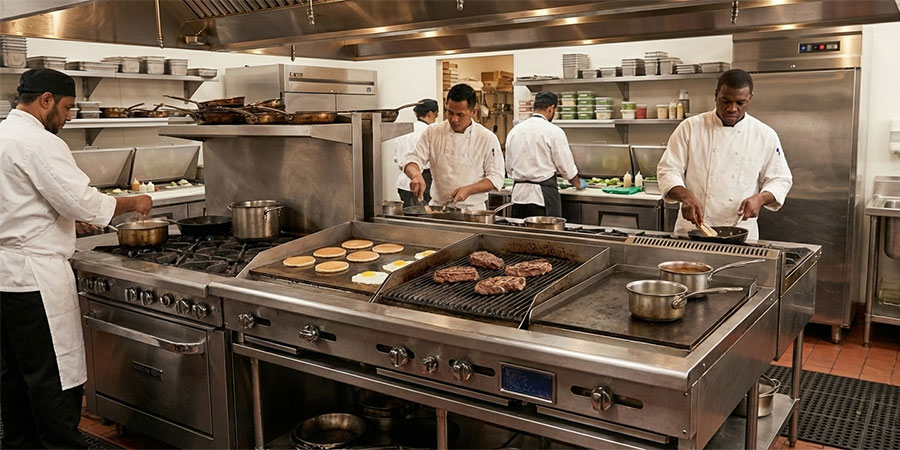
Table of Contents
Match your cooktop setup to your menu, volume, and kitchen workflow
Commercial range top configurations include open burners, griddles, charbroilers, hot tops, French tops, and planchas. Specialty ranges like wok burners, stock pot ranges, and induction cookers serve specific cooking needs. Open burners offer the most versatility for general cooking. Griddles excel at breakfast items and smash burgers. Charbroilers add grill marks and smoky flavor. Most commercial kitchens combine two or more configurations to match their menu requirements.
Your range top configuration directly affects what your kitchen can produce, how fast your cooks can work, and how much flexibility you have during service. A burger restaurant needs different cooking surfaces than an Italian kitchen. A high-volume diner needs different capacity than a fine dining establishment.
This guide breaks down range top configurations for full-size ranges, specialty ranges (wok, stock pot, induction), and countertop units to help you choose the right combination for your restaurant.
Range Top Configuration Overview
Commercial ranges are available with different cooking surface options. Most manufacturers offer combination units that mix multiple surfaces on a single range.
Quick Comparison: Full-Size Range Tops
| Configuration: | Best For: | Heat Type: | Temperature Control: | Typical BTU/Burner: |
| Open burners | Versatile cooking, saute, boiling | Direct flame | Precise | 25,000 - 35,000 |
| Griddle | Breakfast, burgers, sandwiches | Flat surface | Zone control | 20,000 - 30,000 per ft |
| Charbroiler | Steaks, grilled proteins | Radiant heat + grates | High heat | 20,000 - 40,000 per ft |
| Hot top | Stockpots, high-heat searing | Solid plate | Single zone | 25,000 - 35,000 |
| French top | Multi-temperature cooking | Graduated heat | Center hot, edges cool | 30,000 - 40,000 |
| Plancha | Searing, finishing, direct contact | Flat plate | Center hot, edges cool | 25,000 - 35,000 |
Specialty Ranges
| Range Type: | Best For: | Typical BTU: | Key Feature: |
| Wok range | Asian cuisine, stir-fry | 90,000 - 125,000+ | Concave burner cradles round woks |
| Stock pot range | Large batch cooking | 60,000 - 250,000 | Low height, heavy-duty grates |
| Induction | Precision cooking, safety | 1,800 - 3,500 watts | No open flame, instant response |
Open Burners
Open burners are the most common range top configuration. Gas flames heat cookware directly through cast iron grates, giving cooks precise temperature control and immediate response to adjustments.
Open Burner Characteristics
- Heat output: 25,000 - 35,000 BTU per burner (light duty to heavy duty)
- Temperature control: Instant response, precise adjustments
- Cookware: Works with any pot, pan, or wok
- Cleaning: Grates lift out for easy cleaning, but drip pans collect debris
Best Applications
- Saute stations
- Sauce preparation
- Boiling pasta and vegetables
- Wok cooking (with appropriate BTU output)
- General-purpose cooking requiring varied cookware
When to Choose Open Burners
Open burners make sense when:
- Your menu requires diverse cooking methods
- You need maximum flexibility for different cookware sizes
- Cooks need precise, immediate temperature control
- You serve a varied menu with sautes, sauces, soups, and stir-fry
A standard commercial kitchen typically needs at least 4-6 open burners for versatility.
Griddles
Griddles provide a large, flat cooking surface heated evenly across the plate. They excel at cooking multiple items simultaneously and work well for high-volume breakfast and lunch service.
Griddle Characteristics
- Surface types: Steel (standard), chrome (non-stick, easy cleaning), grooved (grill marks)
- Heat output: 20,000 - 30,000 BTU per linear foot
- Temperature control: Zone control on larger units, single thermostat on smaller units
- Plate thickness: 3/4" (standard duty) to 1" (heavy duty) - thicker plates hold heat better
Best Applications
- Pancakes, eggs, bacon, hash browns
- Smash burgers and flat-top sandwiches
- Quesadillas and tortillas
- Grilled cheese and paninis
- High-volume protein cooking (chicken breasts, fish fillets)
When to Choose a Griddle
Griddles make sense when:
- Breakfast represents a significant portion of your menu
- You serve burgers, sandwiches, or other flat-top items
- You need to cook many portions of the same item quickly
- Your menu includes items that benefit from consistent surface contact
Griddle sizing: Plan for 8-12 square inches of griddle space per portion cooked simultaneously. A 36" griddle provides roughly 1,000 square inches of cooking surface.
Charbroilers
Charbroilers cook food over radiant heat with direct contact on metal grates. They produce distinctive grill marks and add smoky flavor that customers associate with grilled food.
Charbroiler Characteristics
- Heat source: Gas flames heat ceramic briquettes, lava rock, or radiant plates
- Heat output: 20,000 - 40,000 BTU per linear foot
- Grate material: Cast iron (heat retention) or steel (easier cleaning)
- Cooking method: Radiant heat from below, drippings vaporize and add flavor
Best Applications
- Steaks and chops
- Burgers (char-grilled style)
- Grilled chicken
- Kebabs and skewers
- Vegetables (peppers, onions, zucchini)
When to Choose a Charbroiler
Charbroilers make sense when:
- Grilled proteins are a menu focus
- You want char marks and smoky flavor
- Customers expect a "grilled" taste profile
- You serve steaks, chops, or grilled burgers
Charbroiler sizing: Plan for 4-6 linear inches per steak/burger you need to cook simultaneously during peak service. A 36" charbroiler handles 6-9 steaks at once.
Hot Tops
Hot tops are solid metal plates heated from below. The entire surface reaches high temperatures (up to 800F), making them ideal for heavy stockpots and high-heat searing.
Hot Top Characteristics
- Surface: Solid steel plate, typically 1/2" to 3/4" thick
- Heat output: 25,000 - 35,000 BTU (heats the entire plate)
- Temperature: Single zone, extremely hot throughout
- Best for: Large, heavy cookware that benefits from stable, intense heat
Best Applications
- Large stockpots for soups, stocks, and stews
- High-heat searing in cast iron
- Reducing sauces at high temperatures
- Operations where heavy pots need stable support
When to Choose a Hot Top
Hot tops make sense when:
- You regularly use large stockpots (20+ quart)
- Your menu features stocks, soups, or braises that simmer for hours
- You need extremely high heat for searing
- Cooks move pots across the surface to adjust cooking intensity
Limitation: Hot tops provide less precise control than open burners. Heat adjusts by moving cookware to different zones on the plate, not by adjusting flame.
French Tops
French tops are a specialized variation of hot tops with graduated temperature zones. The center is hottest (over an open burner or element), and temperature decreases toward the edges.
French Top Characteristics
- Surface: Heavy cast iron or steel plate with concentric rings
- Heat distribution: Hottest in center, progressively cooler toward edges
- Heat output: 30,000 - 40,000 BTU (center burner)
- Temperature control: Move pots between zones rather than adjusting flame
Best Applications
- Classical French cuisine with multiple sauces at different stages
- Operations requiring simultaneous simmering and high-heat cooking
- Kitchens where cooks manage multiple pots continuously
- High-end restaurants with trained line cooks
When to Choose a French Top
French tops make sense when:
- Your menu involves complex sauce work with multiple preparations
- Cooks are trained in classical technique (zone cooking)
- You need to keep several items at different temperatures simultaneously
- Your operation values tradition and technique over speed
Consideration: French tops require more skill to use effectively. The multi-zone approach is intuitive for classically trained cooks but can frustrate those used to individual burner control.
Planchas
Planchas are flat cooking surfaces designed for direct food contact, similar to griddles but with graduated heat zones like French tops. The center is hottest, allowing you to sear in the middle and finish or hold food on the cooler edges.
Plancha Characteristics
- Surface: Thick steel plate, typically polished
- Heat distribution: Hottest in center, cooler toward edges
- Heat output: 25,000 - 35,000 BTU
- Best for: Direct food contact cooking with zone flexibility
Best Applications
- Searing proteins at high heat
- Finishing dishes with precise temperature control
- Spanish and Mediterranean cuisine
- Operations that need griddle functionality with zone cooking
- Seafood (fish, shrimp, scallops)
When to Choose a Plancha
Planchas make sense when:
- You want direct food contact but need temperature zones
- Your menu features seared proteins that need finishing at lower heat
- You serve tapas, Mediterranean, or Spanish cuisine
- Cooks want more control than a standard griddle provides
Plancha vs. Griddle: Griddles have even heat across the surface. Planchas have graduated heat from center to edge, giving cooks more flexibility for cooking and holding.
Specialty Ranges
Beyond full-size range configurations, specialty ranges serve specific cooking applications with purpose-built designs.
Wok Ranges
Wok ranges deliver extreme heat for authentic Asian cooking. The concave burner opening cradles round-bottom woks and directs flames up the sides of the pan for rapid, even heating.
Wok Range Characteristics:
- Heat output: 90,000 - 125,000+ BTU per burner (far exceeds standard burners)
- Burner types: Jet burners, duck burners, 3-ring burners
- Design: Concave opening supports round woks, water-cooled surfaces on some models
- Best for: Stir-fry, flash cooking, high-heat searing
When to Choose a Wok Range:
- Asian cuisine is central to your menu
- You need "wok hei" (breath of the wok) flavor
- High-volume stir-fry production
- Rapid cooking times are critical
Stock Pot Ranges
Stock pot ranges provide concentrated heat and sturdy construction for large, heavy pots. The low-profile design reduces lifting strain and the high BTU output brings large volumes to boil quickly.
Stock Pot Range Characteristics:
- Heat output: 60,000 - 250,000 BTU per burner
- Design: Low height, reinforced grates, often floor-mounted
- Capacity: Supports 40-60+ quart stock pots
- Best for: Soups, stocks, pasta water, large batch cooking
When to Choose a Stock Pot Range:
- You produce stocks, soups, or sauces in large batches
- Catering operations with high-volume prep
- Pasta stations requiring rapid water boiling
- Commissary kitchens or institutional foodservice
Induction Ranges
Induction ranges heat cookware directly through electromagnetic energy. The cooking surface stays cool while pans heat instantly, making them safer and more energy-efficient than gas.
Induction Range Characteristics:
- Heat output: 1,800 - 3,500+ watts (varies by model)
- Types: Countertop, drop-in, freestanding
- Temperature control: Instant response, precise settings
- Best for: Front-of-house cooking, safety-critical environments, precise temperature work
When to Choose Induction:
- No gas lines available or permitted
- Front-of-house display cooking or buffet stations
- Safety is paramount (no open flame)
- Precise temperature control needed for delicate preparations
- You want a cooler kitchen environment
Countertop Ranges
Countertop ranges provide cooking power without a full-size footprint. They work well for satellite stations, food trucks, small kitchens, or supplemental cooking capacity.
Countertop Gas Ranges
- Heat output: 25,000 - 35,000 BTU per burner (comparable to full-size)
- Configurations: 1-10 burners, some with step-up designs
- Fuel options: Natural gas or propane (many are field-convertible)
- Best for: Food trucks, kiosks, supplemental cooking stations
Countertop Electric Ranges
- Heat output: 1,500 - 3,500+ watts per burner
- Types: Coil, solid plate, induction
- Best for: Locations without gas service, portable cooking needs
Portable Gas Stoves (Butane)
- Heat output: 7,000 - 15,000 BTU
- Fuel: Butane canisters
- Best for: Tableside cooking, catering events, outdoor cooking, buffet warmers
Combination Configurations
Most commercial ranges combine multiple cooking surfaces. Manufacturers offer flexible configurations to match specific menu requirements.
Common Combinations
| Configuration: | Typical Setup: | Best For: |
| 6-burner range | 6 open burners over standard oven | General-purpose kitchens, versatility |
| 4-burner + 12" griddle | 4 open burners + griddle section | Diners, cafes with mixed menus |
| 2-burner + 24" griddle | 2 open burners + large griddle | Breakfast-heavy operations |
| 4-burner + 12" charbroiler | 4 open burners + charbroiler | Steakhouses, burger restaurants |
| 6-burner + 24" griddle + charbroiler | Full cooking line | High-volume, diverse menus |
| Hot top + open burners | Mixed configuration | Operations needing both precision and high-heat |
Sizing Your Range
Commercial ranges come in widths from 24" to 72"+. Size based on:
- Menu requirements: What cooking surfaces does your menu demand?
- Peak volume: How many items cook simultaneously during rush?
- Kitchen space: What footprint can your kitchen accommodate?
- Staff count: How many cooks work the line at once?
Rule of thumb: A moderately busy restaurant typically needs 48" to 60" of range top space with a mix of burners and specialty surfaces.
Gas vs. Electric Range Tops
Before choosing configurations, determine your fuel source.
Gas Ranges
- Pros: Instant heat, precise control, preferred by most chefs, lower operating costs
- Cons: Requires gas line, more complex venting, slightly higher maintenance
- BTU options: Light duty (25,000/burner), standard duty (30,000), heavy duty (35,000+)
- Fuel types: Natural gas or liquid propane (LP) - specify when ordering
Electric Ranges
- Pros: No gas line needed, consistent heat, easier installation, cooler kitchen
- Cons: Slower response, higher operating costs, less precise control
- Voltage options: 208V, 240V, 480V - verify your building's electrical capacity
- Best for: Operations without gas access or with induction cooking requirements
Most professional kitchens prefer gas for performance, but electric works well when gas is unavailable.
Making Your Decision
Decision Matrix
| Your Situation: | Recommended Configuration: |
| General restaurant, varied menu | 6-burner gas range with standard oven |
| Breakfast-focused diner | 4-burner + 24" griddle combination |
| Burger or sandwich shop | 2-burner + 36" griddle |
| Steakhouse or grill | 4-burner + 24" charbroiler |
| High-volume diverse menu | 60"+ range with mixed configurations |
| Classical fine dining | French top or hot top + open burners |
| Asian restaurant | Wok range + open burners |
| High-volume soup/stock production | Stock pot range + standard range |
| Small cafe or food truck | Countertop range (gas or induction) |
| Front-of-house display cooking | Induction countertop units |
Questions to Ask Before Purchasing
- What are your highest-volume menu items?
- How many items cook simultaneously during peak service?
- What cooking techniques does your menu require?
- What fuel source is available in your building?
- How much kitchen space can you dedicate to ranges?
- What is your oven requirement? (standard, convection, none)
- Do you need specialty ranges (wok, stock pot) for specific menu items?
Frequently Asked Questions
What is the most versatile range top configuration?
Open burners are the most versatile range top configuration because they work with any size or type of cookware and provide precise temperature control. Most commercial kitchens include at least 4-6 open burners as their primary cooking surface, supplemented by griddles or charbroilers based on menu needs.
How many BTUs do I need for a commercial range?
Commercial range burners typically range from 25,000 BTU (light duty) to 35,000+ BTU (heavy duty) per burner. Choose based on your cooking intensity: light-duty for simmering and reheating, standard duty (30,000 BTU) for most restaurant cooking, and heavy duty for high-heat applications like wok cooking or rapid boiling. Specialty ranges like wok burners require 90,000-125,000+ BTU.
What is the difference between a hot top and a French top?
A hot top is a solid metal plate that heats evenly to very high temperatures across the entire surface. A French top has graduated temperature zones with the center being hottest and edges progressively cooler. Hot tops work best for high-heat searing and large stockpots. French tops allow cooks to maintain multiple items at different temperatures by positioning them in different zones.
What is the difference between a plancha and a griddle?
A griddle has even heat distribution across the entire flat cooking surface. A plancha has graduated heat zones with the center being hottest and the edges cooler. Both are designed for direct food contact, but planchas give cooks more flexibility to sear in the hot center and hold or finish food on the cooler edges.
What size commercial range do I need?
Most restaurants need 48" to 60" of range top space. Size depends on your menu complexity and peak volume. A small cafe might work with 36", while a high-volume kitchen with a diverse menu may need 72" or multiple range units. Plan for at least 4 burners plus any specialty surfaces (griddle, charbroiler) your menu requires.
Should I choose gas or electric for my commercial range?
Most professional kitchens prefer gas ranges for instant heat response, precise control, and lower operating costs. Electric ranges work well when gas is unavailable or for specific applications like induction cooking. Induction offers the fastest response time and precise control but requires compatible cookware. Verify your building's gas line capacity or electrical service before purchasing.
When do I need a wok range instead of a standard range?
You need a wok range when Asian stir-fry is central to your menu. Standard range burners produce 25,000-35,000 BTU, while wok burners produce 90,000-125,000+ BTU. This extreme heat is required for authentic "wok hei" flavor and rapid stir-fry cooking. A standard burner cannot replicate proper wok technique.
How do I clean a commercial griddle?
Clean commercial griddles after each service by scraping the surface with a griddle scraper while still warm, then wiping with a damp cloth or griddle pad. For deeper cleaning, use a commercial griddle cleaner according to manufacturer instructions. Chrome griddles require gentler cleaning to avoid surface damage. Season steel griddles with oil to prevent rust and maintain non-stick properties.
Related Guides
- Commercial Range Buying Guide - Complete guide to purchasing commercial ranges
- Commercial Griddle Buying Guide - Detailed griddle selection and sizing
- Commercial Induction Equipment Guide - Induction technology and applications
- Commercial Cooking Equipment Guide - Overview of all cooking equipment types
- Commercial Kitchen Equipment Checklist - Full equipment list by category
Shop Commercial Ranges
Find the right range configuration for your kitchen:
- Commercial Restaurant Ranges - All range configurations
- Commercial Gas Ranges - Gas-powered ranges with various configurations
- Commercial Electric Ranges - Electric range options
- Wok Ranges & Burners - High-BTU wok cooking equipment
- Stock Pot Ranges & Burners - Heavy-duty stock pot cooking
- Induction Cookers & Stovetops - Countertop and drop-in induction
- Countertop Gas Ranges - Compact gas cooking
- Countertop Electric Ranges - Compact electric cooking
- Charbroilers - Standalone charbroiler units
Share This!