Food Display Cases: How to Choose the Right One for Your Operation
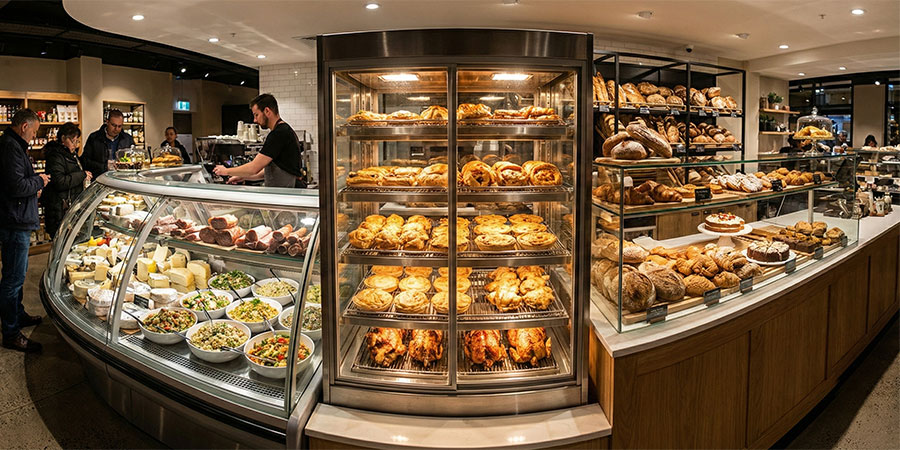
Table of Contents
How to match the right commercial display case to your food, your floor space, and your sales strategy
A food display case does two jobs at once: it keeps food at a safe temperature and puts it in front of customers at exactly the right moment. Choosing the wrong type costs you sales and can create food safety problems. This post breaks down the main types, what to look for, and how to use display cases to actually move more product.
Your display case is doing sales work every minute your doors are open. Customers scan it before they talk to anyone on your staff. They decide what looks good, what they want to try, and whether they're adding something to their order - all based on what they see through that glass. One-third of consumers made an impulse purchase in the past week, according to Ipsos research cited by The Food Institute (2023). That's not a coincidence. It's the result of good merchandising.
The problem is that "display case" covers a wide range of equipment with very different purposes. A refrigerated deli case and a heated pastry warmer are both display cases, but they serve completely different foods and require completely different decisions. Getting this wrong means food that doesn't stay at the right temperature, products that don't look their best, and missed sales opportunities.
This post walks through the main types of commercial food display cases, the features that actually matter, and how to think about display as a sales tool - not just a storage solution.
The Main Types of Commercial Food Display Cases
Not all display cases are built for the same job. The first decision is always about temperature - what does your food need, and what does your operation require?
Refrigerated Display Cases
Refrigerated cases are the workhorses of deli counters, prepared food sections, and grab-and-go setups. They hold TCS (temperature control for safety) foods at 41°F or below, as required by the FDA Food Code 2022. That covers everything from sliced meats and cheeses to prepared salads, sushi, and cold sandwiches.
The format matters as much as the temperature. Curved glass cases give customers a clear view of product from multiple angles and work well for full-service counters where staff serve from behind. Straight glass cases are easier to clean and better for self-service setups. Coffin cases - the open-top horizontal units common in grocery delis - maximize product visibility and allow customers to reach in directly, which works well for high-volume grab-and-go.
Refrigerated deli display cases come in single-deck and multi-deck configurations. Multi-deck cases fit more product in a smaller footprint and are common in cafeteria and fast-casual settings where variety is the draw.
Heated Display Cases
Heated cases keep hot foods at 135°F or above - the minimum safe holding temperature for hot TCS foods under the FDA Food Code 2022. They're built for fried foods, rotisserie items, hot sandwiches, soups, and any prepared food that needs to stay warm and appetizing through a service period.
Humidity control is the detail most operators overlook. Dry heat keeps fried foods crispy but dries out baked goods. Moist heat works better for rotisserie chicken and other proteins. Some heated display warmers and cases offer adjustable humidity, which gives you more flexibility across different menu items.
Dry (Non-Refrigerated) Bakery Display Cases
Not everything needs temperature control. Whole cakes, bread loaves, cookies, and many pastries hold fine at room temperature for a service period - they just need protection from handling and a presentation that makes them look worth buying.
Dry bakery cases do exactly that. They keep product clean, reduce handling, and create a focal point that draws customers in. Paired with good lighting and thoughtful arrangement, a dry case turns a counter display into a real merchandising moment. Dry and refrigerated bakery display cases often come in combination units that let you display both ambient and chilled items in a single footprint.
Combination and Specialty Cases
Some operations need more flexibility. Combination cases split refrigerated and ambient zones in one unit, which is useful for bakeries that sell both pastries and cold beverages. Air curtain merchandisers use a curtain of cold air instead of glass doors to keep product accessible while maintaining temperature - a format that works well for high-traffic grab-and-go. For a deeper look at how those work, the air curtain merchandiser post covers the tradeoffs.
What to Look for When Choosing a Display Case
Once you've identified the right temperature category, the next layer of decisions is about features. These are the ones that actually affect your day-to-day operation.
Lighting
Lighting matters more than most operators realize. LED lighting inside a display case does two things: it makes food look better, and it runs cooler than older fluorescent options, which reduces the load on the refrigeration system. Warm-toned LEDs work well for baked goods and prepared foods. Cooler tones suit fresh produce and cold beverages. The goal is to make the food look the way it looks at its best - not washed out, not shadowed.
Glass Configuration
- Curved glass - Better sightlines from a distance, more visual impact, harder to clean
- Straight glass - Easier maintenance, better for self-service, slightly less dramatic presentation
- Low-profile - Keeps the counter open and visible from across the room, good for cafes and bakeries
- Full-height - Maximum product capacity, works well for high-volume delis
Energy Efficiency
Display cases run continuously. ENERGY STAR certified commercial refrigerators are on average 20 percent more energy efficient than standard models, according to the U.S. EPA ENERGY STAR program. Over the life of a unit, that difference adds up to real money. Look for ENERGY STAR certification when comparing refrigerated options, and check the unit's rated wattage against comparable models.
Footprint and Capacity
Measure your available floor space before you start shopping. Display cases come in standard widths (typically 24", 36", 48", and 72") and the right size depends on both your space and your product volume. A case that's too large for your product looks sparse and uninviting. A case that's too small forces you to rotate product constantly and limits what you can show.
Food Safety Is Not Optional
Display cases are food safety equipment first. The visual merchandising benefits are real, but they don't matter if your food isn't being held at the right temperature.
The FDA Food Code 2022 is clear: cold TCS foods must be held at 41°F or below, and hot TCS foods must be held at 135°F or above. These aren't suggestions - they're the line between safe food and a health code violation. Your display case needs to maintain those temperatures consistently, not just when it's first loaded.
A few practices that protect you:
- Use a calibrated thermometer to verify case temperature at the start of each service period, not just when you install the unit
- Don't overload cases - airflow is what maintains temperature, and packing product too tightly blocks it
- Track how long product has been in the case and rotate or discard according to your HACCP plan
- Clean and sanitize cases on a regular schedule; buildup on coils and fans reduces efficiency and can affect temperature
For a full breakdown of safe holding temperatures and what the rules mean for your operation, the food temperature requirements post is worth reading before you set up any new display.
How Display Cases Drive Sales
The business case for investing in good display equipment is straightforward. Acosta Group research cited by The Food Institute (2023) found that 61% of shoppers usually plan purchases ahead of time but sometimes buy things on impulse. Display cases are one of the primary triggers for that impulse.
Visibility converts browsers into buyers. A customer who came in for a coffee might add a pastry if it's displayed at eye level with good lighting. A deli customer who planned to order a sandwich might add a side salad if it's visible and looks fresh. These aren't accidental sales - they're the result of intentional merchandising.
The data on prepared foods specifically is worth paying attention to. FMI (2023) found that 68% of shoppers intend to continue purchasing deli-prepared foods, with 20% indicating plans to increase these purchases. Another 25% of shoppers cite replacing restaurant meals with foodservice or deli options. That's a growing market, and display cases are the primary tool for capturing it.
What actually moves product:
- Place your highest-margin items at eye level, not at the bottom of the case
- Keep the case full - sparse displays signal that product isn't fresh or popular
- Use display risers and stands to create height variation and draw the eye to featured items
- Rotate product so the freshest items are visible at the front
- Clean the glass frequently - smudges and condensation kill the visual impact
Research from 84.51° cited by The Food Institute (2023) found that 58% of shoppers say they tried a new snack item because the flavor or texture looked appealing. That's the display case doing its job.
Matching Case Type to Operation
Different operations have different needs. Here's a quick reference for the most common setups:
| Operation Type: | Primary Case Type: | Key Consideration: |
| Full-service deli | Refrigerated curved glass | Full-service counter depth, multi-deck for variety |
| Bakery | Dry or combination case | Lighting quality, ambient temperature control |
| Cafe / coffee shop | Low-profile refrigerated or dry | Counter height, compact footprint |
| Fast casual restaurant | Multi-deck refrigerated | Self-service access, high product turnover |
| Cafeteria / buffet | Heated display case | Humidity control, consistent hot-hold temp |
| Grab-and-go retail | Open-air or coffin case | Accessibility, high-volume capacity |
The food display and merchandising equipment category covers the full range of options if you're comparing across types.
Bakery-Specific Considerations
Bakeries have a particular challenge: the product is often the most visually compelling food in any foodservice setting, but it's also the most sensitive to how it's displayed. A croissant that looks perfect at 8am can look tired by noon if it's in the wrong case.
Temperature and humidity are the two variables that matter most for baked goods. Refrigeration can make some pastries go stale faster. Dry heat can dry out items that need a bit of moisture. The right bakery display case for your operation depends on what you're selling and how long it needs to hold.
A few practical notes:
- Croissants, danishes, and laminated pastries hold better at ambient temperature for short service windows
- Cream-filled items and anything with fresh fruit need refrigeration
- Whole cakes and tarts can often display at ambient temperature for a service period if the filling is stable
- Bread holds well at ambient but goes stale faster in a refrigerated case
Combination cases that offer both ambient and refrigerated zones give bakeries the most flexibility without requiring two separate units.
Frequently Asked Questions
What temperature should a refrigerated display case maintain?
Cold TCS foods must be held at 41°F or below, per the FDA Food Code 2022. Your case should maintain this temperature consistently throughout the service period, not just when first loaded. Verify with a calibrated thermometer at the start of each shift.
Can I use a dry display case for items that need refrigeration?
No. Dry cases don't provide temperature control, so they're only appropriate for foods that are safe at ambient temperature - whole cakes, bread, cookies, and similar items. Anything that requires refrigeration (cream-filled pastries, deli meats, prepared salads) needs a refrigerated case.
How do I keep a heated display case from drying out my food?
Look for a case with adjustable humidity control. Dry heat is fine for fried foods but will dry out proteins and baked goods. Moist heat settings help maintain texture for rotisserie items and hot sandwiches. Also avoid holding food longer than your HACCP plan allows - even the best case can't compensate for food that's been held too long.
What's the difference between a curved glass and straight glass display case?
Curved glass cases offer better sightlines from a distance and a more dramatic presentation, which works well for full-service counters. Straight glass is easier to clean and better suited to self-service setups. The choice usually comes down to your service model and how much counter space you have for cleaning access.
How often should I clean my display case?
Glass should be cleaned at least daily - smudges and condensation significantly reduce visual impact. Interior surfaces, shelves, and drip trays should be cleaned and sanitized according to your local health code requirements, typically at least weekly. Coils and fans should be inspected and cleaned on a regular maintenance schedule to maintain efficiency.
Do display cases need to be ENERGY STAR certified?
It's not required, but it's worth prioritizing. ENERGY STAR certified commercial refrigerators are on average 20 percent more energy efficient than standard models, according to the U.S. EPA. For equipment that runs continuously, that efficiency difference translates to meaningful savings over the life of the unit.
How do I decide between a self-service and full-service display case?
Self-service cases work best for high-volume grab-and-go operations where speed matters and staff can't be dedicated to serving from behind the counter. Full-service cases are better when you want staff to guide customers through options, upsell, or handle product that shouldn't be handled by customers directly. Many operations use both - a full-service deli case for custom orders and a self-service case for pre-packaged grab-and-go items.
Related Resources
- Food Display & Merchandising Equipment - Full category of display and merchandising equipment for foodservice operations
- Refrigerated Deli Display Cases - Curved glass, straight glass, and multi-deck refrigerated cases for deli and prepared food
- Heated Display Warmers & Cases - Hot-hold display cases for fried foods, rotisserie, and hot prepared items
- Bakery & Pastry Displays - Display cases built for baked goods, pastries, and desserts
- Merchandising Refrigeration Guide - In-depth buying guide for refrigerated merchandising equipment
Share This!