How to Attract New Customers to Your Restaurant
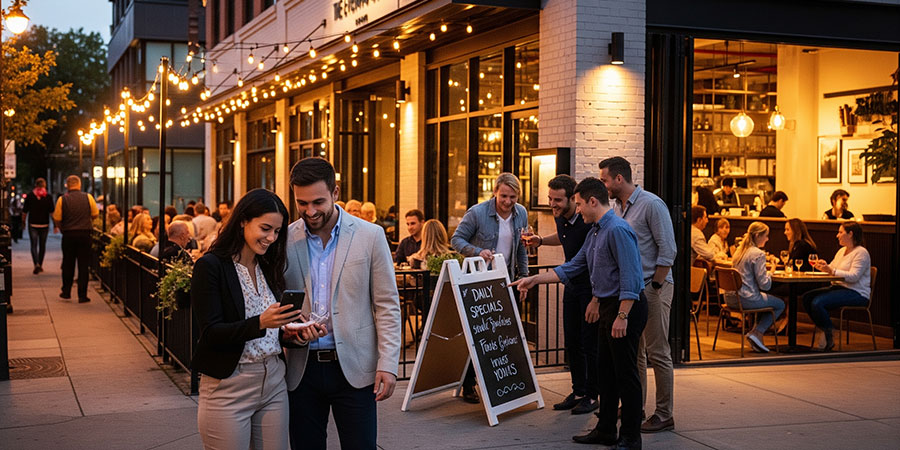
Table of Contents
Why First-Time Visitors Are the Hardest to Win - and How to Make Your Restaurant Irresistible to Them
Attracting new customers requires making your restaurant discoverable, trustworthy, and compelling to people who have never tried you. This post covers five proven strategies: optimizing local search visibility, building social proof through reviews and content, creating physical curb appeal that stops foot traffic, giving people compelling reasons to try you through events and incentives, and turning first visits into word-of-mouth marketing.
Getting new customers through your door is harder than ever. With forty-six percent of all Google searches having local intent according to BrightLocal's 2025 research, and ninety-seven percent of consumers reading reviews before choosing a restaurant (BrightLocal, 2026), the path to discovery has fundamentally changed. People research before they visit, compare options across multiple platforms, and rely heavily on social proof from strangers.
The challenge isn't just being good - it's being discoverable, trustworthy, and compelling enough to convince someone to choose you over the dozens of other options in their consideration set. This requires a different approach than traditional advertising. Instead of pushing messages at potential customers, you need to make your restaurant easy to find, impossible to ignore, and irresistible to try.
The strategies below focus on operational and strategic changes that make your restaurant more attractive to first-time visitors - not just which advertising channels to use. For specific advertising tactics and channel strategies, see our guide on how to advertise your restaurant. This post covers the foundational work that makes advertising effective.
Make Your Restaurant Easy to Find Online
Local search optimization is the foundation of customer acquisition. When someone searches for restaurants in your area, you need to appear in results with complete, compelling information that drives visits.
Google Business Profile optimization is non-negotiable. Google reports that businesses with complete profiles are seventy percent more likely to attract location visits and fifty percent more likely to be considered for a purchase. Yet most restaurants leave their profiles incomplete or outdated.
Complete every section of your Google Business Profile. Include accurate hours (including holiday hours), phone number, website, menu link, price range, and detailed business description. Add your full menu with prices if possible. Select all relevant categories and attributes (outdoor seating, delivery, reservations, etc.). The more complete your profile, the more likely Google is to show you in relevant searches.
Upload high-quality photos regularly. Businesses with photos receive forty-two percent more requests for directions and thirty-five percent more clicks to their websites according to Google. Focus on:
- Signature dishes with professional-quality food photography
- Interior dining spaces showing ambiance and seating
- Exterior shots showing your storefront and signage
- Behind-the-scenes kitchen or staff photos that build personality
- Special events or seasonal decorations
Respond to all Google reviews promptly. BrightLocal's 2026 research shows that eighty percent of consumers are more likely to use a business that responds to reviews. Response demonstrates that you're active, engaged, and care about customer feedback. Thank positive reviewers and address negative reviews constructively.
Website Basics That Support Discovery
Your website doesn't need to be elaborate, but it must provide essential information quickly and clearly:
- Menu with current prices - The number one thing people want to see
- Location and hours - Prominently displayed, not buried in a footer
- Contact information - Phone number, email, reservation link
- Photos of food and space - Visual proof of what to expect
- Mobile optimization - Most local searches happen on phones
For comprehensive strategies on improving your online presence, see our restaurant local listings guide, which covers Google Business Profile, review platforms, and directory management in detail.
Build Social Proof That Drives Trial
Reviews and social media content function as trust-builders for people who have never visited your restaurant. They answer the fundamental question every potential customer asks: "Is this place worth trying?"
The statistics are overwhelming. BrightLocal's 2026 research reveals that forty-one percent of consumers always read reviews before choosing a restaurant (up from twenty-nine percent previously), and sixty-eight percent require a restaurant to have four stars or higher before they'll visit. Seventy-four percent only care about reviews from the last three months, meaning your review strategy must be ongoing, not one-time.
Actively request reviews from satisfied customers. The best time to ask is immediately after a positive experience - when the meal was excellent, when a guest compliments the food, when someone mentions they'll be back. Train staff to say something like, "We'd love to hear about your experience on Google if you have a moment." Make it easy by providing a direct link via text or email.
Respond to every review, positive and negative. Thank guests who leave positive reviews with specific, personal responses. For negative reviews, acknowledge the issue, apologize sincerely, explain what you're doing differently, and invite them back. Public responses show potential customers that you take feedback seriously.
Monitor review platforms beyond Google. While Google dominates local search, people also check platform-specific reviews, social media, and specialized restaurant sites. Set up alerts so you're notified of new reviews across all platforms.
Social Media as a Discovery Tool
Belle Communications and Nation's Restaurant News research from 2025 found that seventy-three percent of Millennials and Gen Z visited a restaurant because of social media content. More significantly, fifty-five percent said positive social media reviews were most likely to drive trial, compared to just twenty-nine percent for discounts.
Create share-worthy content consistently. Focus on:
- High-quality food photography that makes people hungry
- Behind-the-scenes content showing preparation and people
- Customer photos and testimonials (with permission)
- Special events, seasonal items, and limited-time offerings
- Staff spotlights that build personality and connection
Make it easy for customers to share their experiences. Create photo-worthy presentation, good lighting in dining areas, and moments worth capturing. When guests post about you organically, it reaches their networks with built-in credibility.
| Channel: | Impact on First Visits: | Key Action: | Source: |
| Google Business Profile | 70% more likely to visit with complete profile | Complete all sections, add photos weekly, respond to reviews | Google, Current |
| Online Reviews | 68% require 4+ stars before visiting | Request reviews after positive experiences, respond to all feedback | BrightLocal, 2026 |
| Social Media Content | 73% of Millennials/Gen Z visited from social | Post high-quality food photos, behind-the-scenes content, customer features | Belle/NRN, 2025 |
| Social Media Reviews | 55% say social reviews drive trial vs 29% for discounts | Encourage customer posts, share user-generated content | Belle/NRN, 2025 |
| Word of Mouth | #1 restaurant discovery channel | Deliver exceptional experiences that people talk about | Toast, 2026 |
For detailed strategies on building your social media presence, see our restaurant social media guide.
Create Curb Appeal That Stops Foot Traffic
Physical visibility matters enormously for restaurants in high-traffic areas. Your exterior is the first impression for walk-by traffic and the confirmation for people who found you online.
Invest in clear, attractive signage. Your sign should be visible from a distance, readable at a glance, and communicate what you are (Italian, BBQ, cafe, etc.). Illuminated signs extend visibility into evening hours when many people are deciding where to eat.
Use sidewalk signs strategically. A-frame sign boards placed on sidewalks capture attention from pedestrians and drivers. Use them to highlight:
- Daily specials or featured dishes
- Happy hour times and offerings
- Lunch specials for nearby office workers
- Seasonal items or limited-time promotions
Maintain an inviting exterior. Clean windows, swept sidewalks, well-maintained landscaping, and good lighting all signal that you care about details. Neglected exteriors suggest neglected food and service.
Leverage outdoor seating as marketing. Outdoor restaurant furniture serves double duty - it provides additional seating capacity and acts as a billboard. People dining outside create activity and social proof that draws attention from passersby. A busy patio signals popularity and quality.
Quick curb appeal improvements:
- Refresh paint and signage - Faded or damaged exteriors signal neglect
- Add lighting - Well-lit exteriors feel safer and more inviting
- Display menus prominently - Let people see what you offer before committing to enter
- Create window displays - Showcase signature dishes, awards, or press coverage
- Maintain cleanliness obsessively - Dirty windows or trash near entrances kill first impressions
- Use seasonal decorations - Show that you're active and engaged with the community
Physical appearance communicates quality before a potential customer ever tastes your food. Make sure your exterior matches the experience you deliver inside.
Give People a Compelling Reason to Try You
Even when people know about your restaurant and trust that it's good, they often need a specific reason to choose you over familiar options. Creating compelling trial incentives reduces the perceived risk of trying something new.
First-visit incentives lower the barrier to trial. Offering something special for first-time guests - a complimentary appetizer, a discount on their first order, or a free dessert - makes the decision easier. The goal isn't to discount your way to profitability; it's to get people through the door once so they can experience your quality.
Host themed events that attract new audiences. Wine tastings, chef's table dinners, cooking classes, live music nights, or holiday celebrations give people a specific reason to visit. Events create urgency (limited seating, one-time opportunity) and provide social proof (other people will be there).
Participate in community food festivals and events. Local food weeks, farmers markets, street festivals, and charity events put you in front of people who might not otherwise discover you. These events lower the commitment threshold - people can try a sample or single dish without committing to a full meal.
Create partnerships with complementary businesses. Team up with nearby breweries, wineries, theaters, or entertainment venues for cross-promotions. "Show your theater ticket for a discount" or "Brewery tour participants get a free appetizer" brings new customers from established audiences.
Develop signature items worth seeking out. The National Restaurant Association's 2025 research found that sixty-four percent of full-service diners say the overall experience matters more than price. Having a dish or experience that people can't get elsewhere - a unique preparation, a locally famous item, an Instagram-worthy presentation - gives people a specific reason to choose you.
Trial-driving tactics:
- Limited-time seasonal menus - Create urgency and newsworthiness
- Collaboration dinners with other chefs - Attract both audiences
- Charity nights - Percentage of sales goes to local cause, attracts community-minded diners
- Industry nights - Special pricing for service industry workers builds word-of-mouth
- Tasting menus - Lower-commitment way to experience your range
- Pop-up concepts - Test new ideas while generating buzz
For comprehensive strategies on promotions and incentives, see our restaurant coupons and promotions guide. For broader marketing approaches, our restaurant marketing guide covers integrated strategies for attracting and retaining customers.
Turn First Visits Into Word-of-Mouth Marketing
Toast's 2026 research identifies word of mouth as the number one restaurant discovery channel. Every first-time visitor is a potential advocate who can bring you dozens more customers - or a detractor who warns people away.
The stakes are high. Bloom Intelligence's 2026 data shows that seventy-seven percent of first-time guests never return. That means your first impression isn't just important - it's usually your only impression. Making that first visit exceptional determines whether someone becomes a regular customer and advocate or disappears forever.
Exceed expectations systematically. When the food is better than expected, the service more attentive than anticipated, and the value stronger than assumed, people tell others. This doesn't require perfection - it requires consistently delivering slightly more than promised.
Create shareable moments. Beautiful plating, unexpected touches (complimentary amuse-bouche, handwritten thank-you notes, birthday candles without being asked), and memorable presentations give people something to photograph and talk about. These moments extend your marketing reach through customer networks.
Make the first visit feel special. Train staff to identify and acknowledge first-time visitors. A simple "Is this your first time with us? Welcome!" followed by a brief orientation or recommendation makes people feel noticed. Some operators provide a small complimentary item for first visits - a signature appetizer, a dessert, a drink - to create a memorable impression.
Follow up after the first visit. If you captured contact information (through reservations, loyalty program signup, or payment), a simple thank-you email or text asking about their experience shows you care. This is also an opportunity to request a review or offer an incentive to return soon.
The goal is making the first experience so positive that new customers naturally tell friends, post on social media, and return themselves. For detailed strategies on converting first-time visitors into repeat customers, see our guide on how to create repeat customers for your restaurant.
Frequently Asked Questions
What is the most effective way to attract new customers to a restaurant?
Local search optimization through a complete Google Business Profile is the most effective foundation. With forty-six percent of Google searches having local intent (BrightLocal, 2025) and seventy percent higher visit likelihood for complete profiles (Google), ensuring you appear in local search results with compelling information is critical. Combine this with active review management and social proof building for maximum impact.
How important are online reviews for attracting new restaurant customers?
Online reviews are critically important. BrightLocal's 2026 research shows that ninety-seven percent of consumers read reviews for local businesses, forty-one percent always read reviews before choosing a restaurant, and sixty-eight percent require four stars or higher before visiting. Additionally, eighty percent are more likely to use a business that responds to reviews, making review management essential for customer acquisition.
Should I offer discounts to attract new customers to my restaurant?
Strategic first-visit incentives can lower the barrier to trial, but discounting shouldn't be your primary strategy. Belle Communications research from 2025 found that fifty-five percent of consumers say positive social media reviews are most likely to drive trial, compared to just twenty-nine percent for discounts. Focus on building social proof, creating compelling reasons to visit (events, unique menu items), and delivering exceptional first experiences rather than competing primarily on price.
How can I make my restaurant more visible to people walking by?
Invest in clear, attractive signage visible from a distance, use sidewalk A-frame signs to highlight specials and offerings, maintain an inviting exterior with clean windows and good lighting, and leverage outdoor seating as marketing. People dining outside create activity and social proof that attracts attention. Ensure your menu is displayed prominently so passersby can see what you offer before committing to enter.
What role does social media play in attracting new restaurant customers?
Social media is increasingly important, especially for younger demographics. Belle Communications and Nation's Restaurant News research from 2025 found that seventy-three percent of Millennials and Gen Z visited a restaurant because of social media content. Focus on high-quality food photography, behind-the-scenes content, customer features, and share-worthy moments rather than promotional posts. Authentic content that showcases your food and personality drives discovery more effectively than advertising.
How do I compete with established restaurants that already have loyal customers?
Focus on making your restaurant discoverable and compelling to people actively searching for options. Optimize your Google Business Profile, actively build reviews and social proof, create unique menu items or experiences worth seeking out, and participate in community events that introduce you to new audiences. The National Restaurant Association's 2025 research shows that sixty-four percent of full-service diners prioritize experience over price, meaning quality and uniqueness matter more than undercutting competitors.
What should I do immediately after someone visits my restaurant for the first time?
Make the first visit exceptional by exceeding expectations, creating shareable moments, and making guests feel welcomed and valued. If you captured contact information, follow up with a thank-you message asking about their experience and inviting them back. Request a review if the experience was positive. Remember that seventy-seven percent of first-time guests never return (Bloom Intelligence, 2026), so the first impression determines whether someone becomes a repeat customer and advocate.
Related Resources
- Restaurant Marketing Guide - Comprehensive strategies for attracting and retaining customers through integrated marketing
- Restaurant Local Listings Guide - Complete guide to Google Business Profile, review platforms, and directory management
- Restaurant Social Media Guide - Platform-specific strategies for building social media presence and engagement
- How to Advertise Your Restaurant on Any Budget - Specific advertising channels and tactics for restaurant promotion
- How to Create Repeat Customers for Your Restaurant - Retention strategies for converting first-time visitors into loyal regulars
Share This!